Rust commerce. AI-native by design. Built in public.
Commerce. Rebuilt for the AI era.
A new commerce foundation in Rust. AI works with your products, business
knowledge and native actions. Connect agents, automate merchant work and
build apps that extend the business itself.
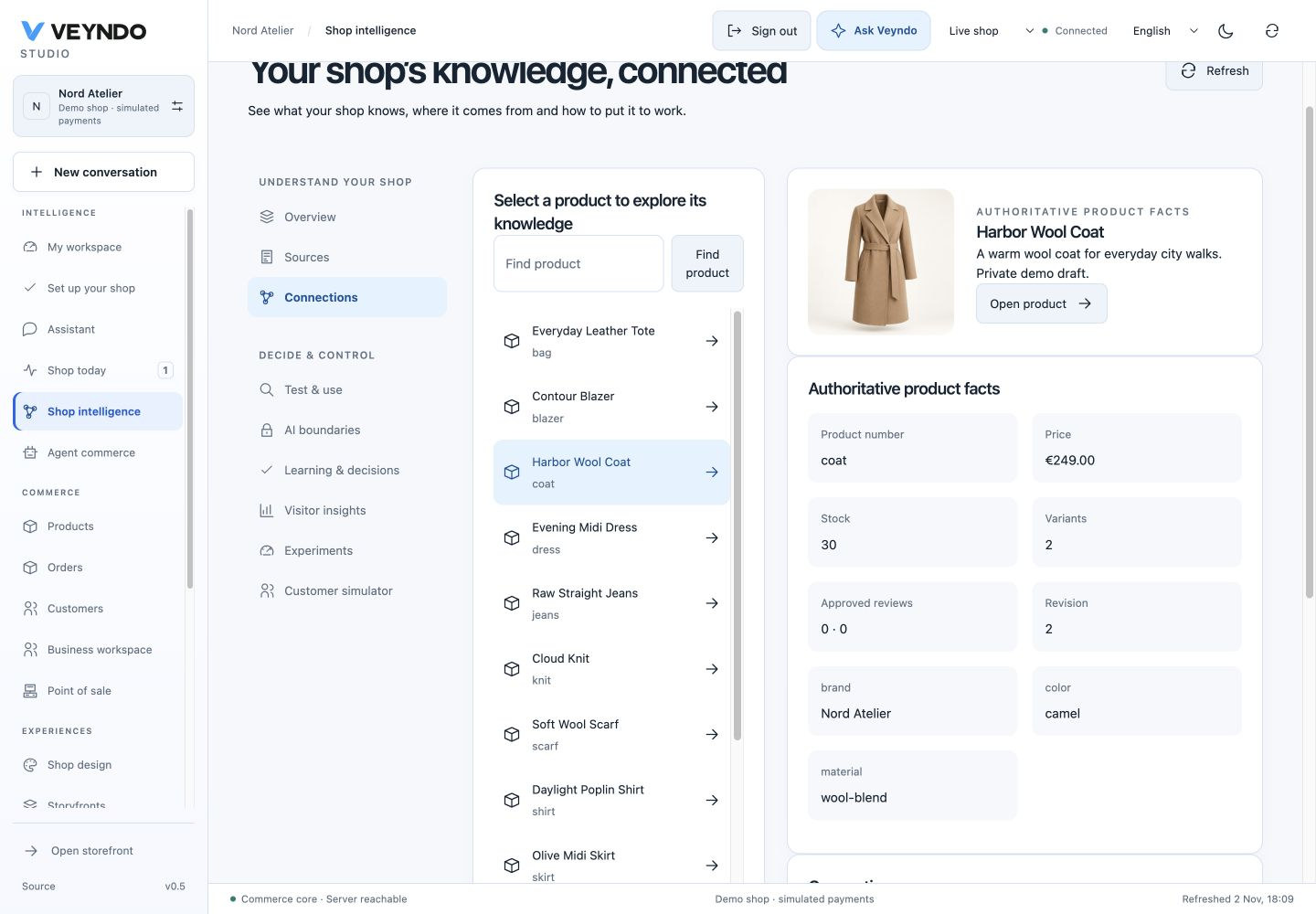
Knowledge. Decisions. Actions. One connected foundation.
Studio, agents and apps use the same native commerce operations, current permissions and product context. Intelligence is part of how the business works.
AI for merchant and shopper
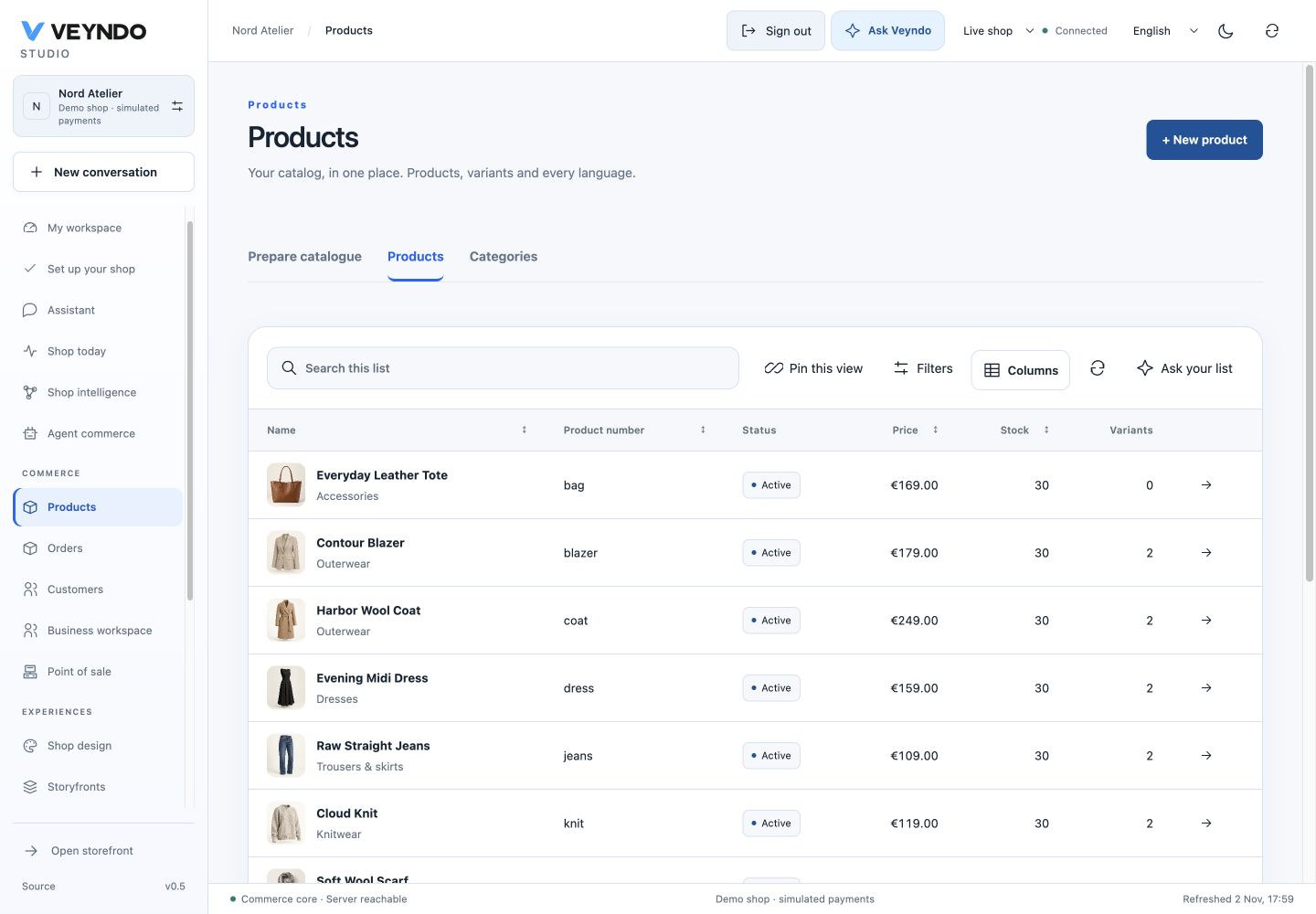
Ask the merchant assistant, prepare catalog changes and advise shoppers with current product knowledge. Sources, proposals and native actions stay connected. Choose OpenAI, Anthropic or a local model.
Connect order events, rules, delays, documents and installed app actions in visual Flows. Add AI proposals and source review to the process; inspect each executed step.
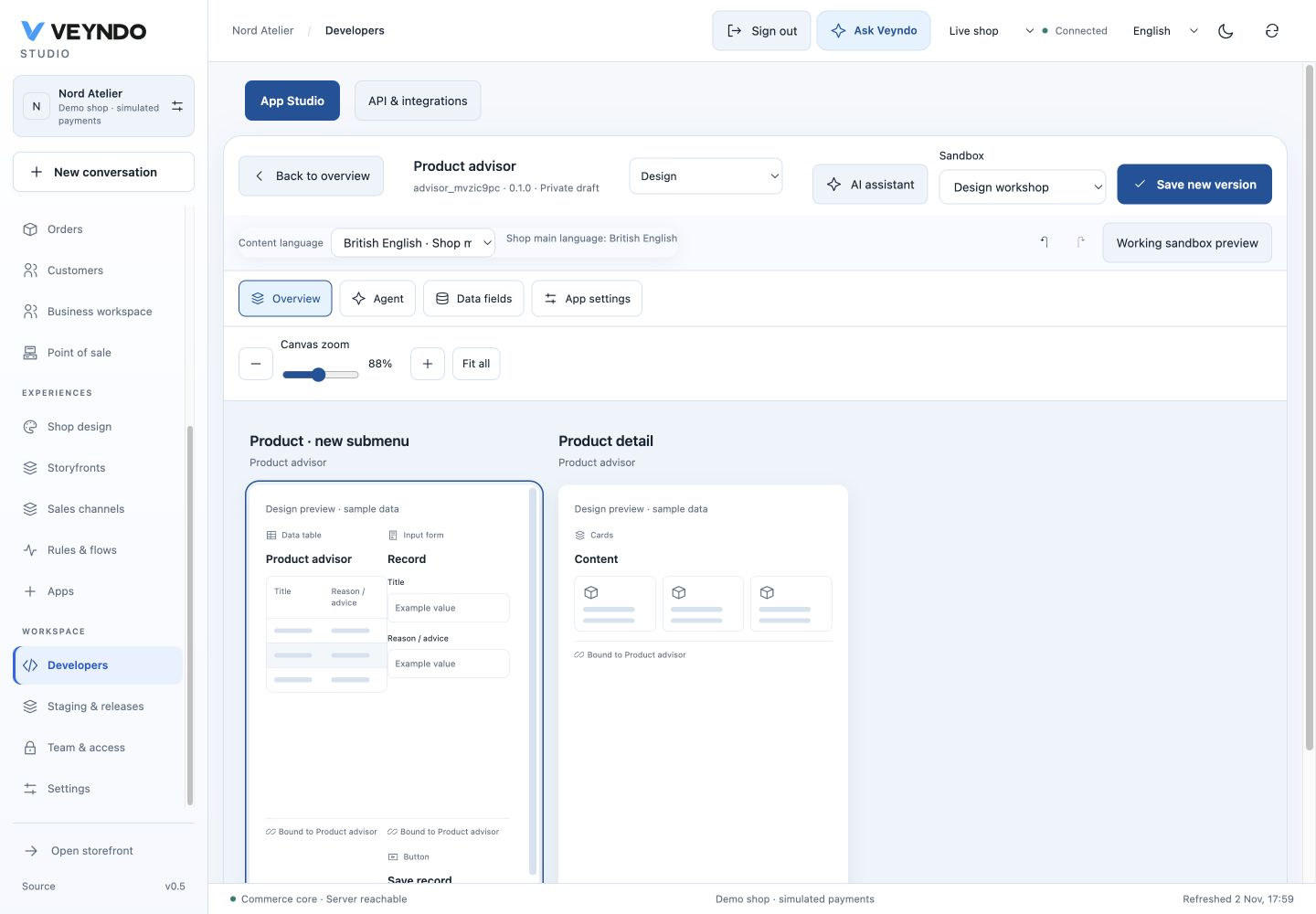
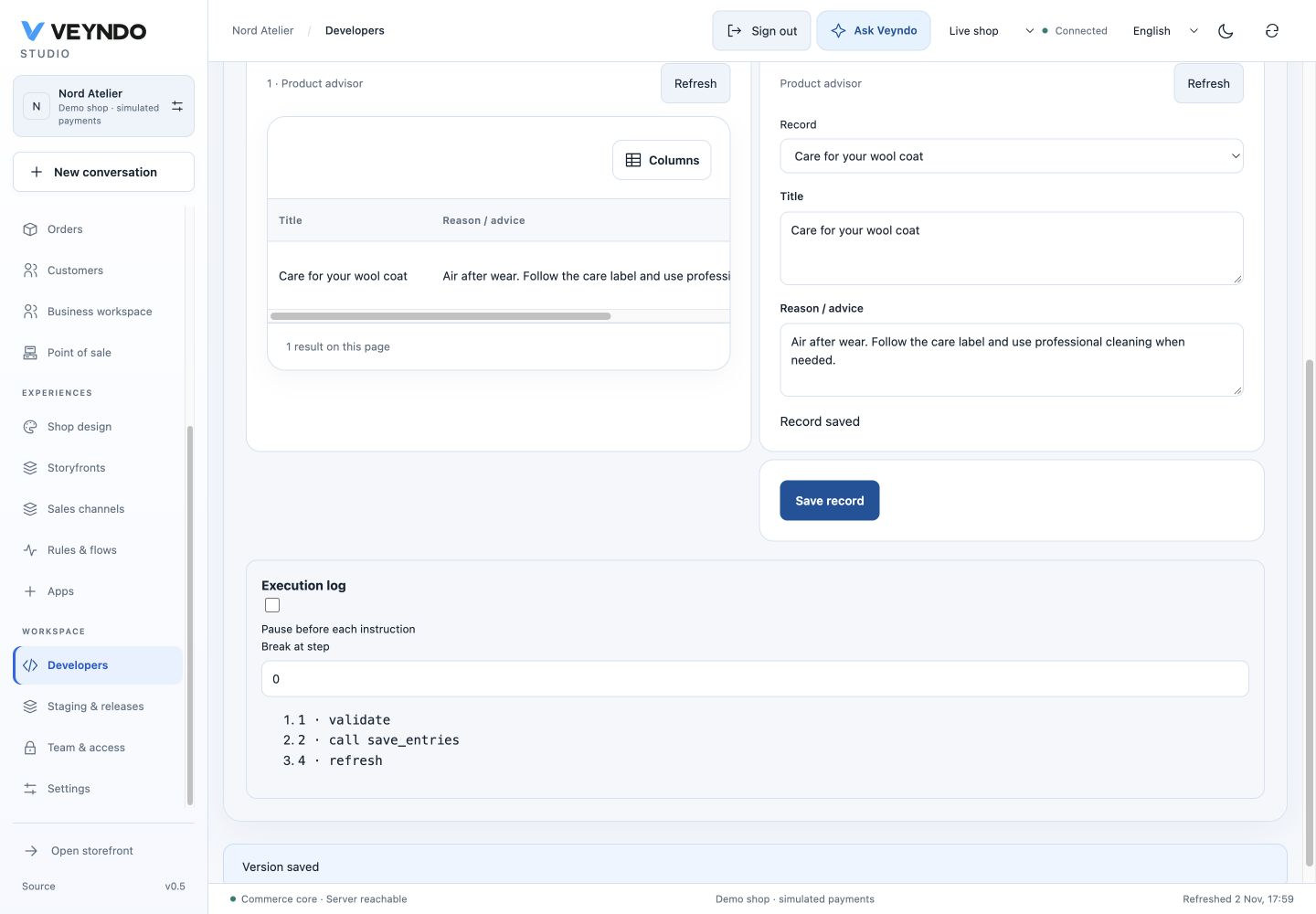
Turn a merchant description into connected private forms, product relations, file uploads, settings and administration views. Visual App Studio and coding agents share the versioned definition. Check upgrades against saved records and current consumers before installing.
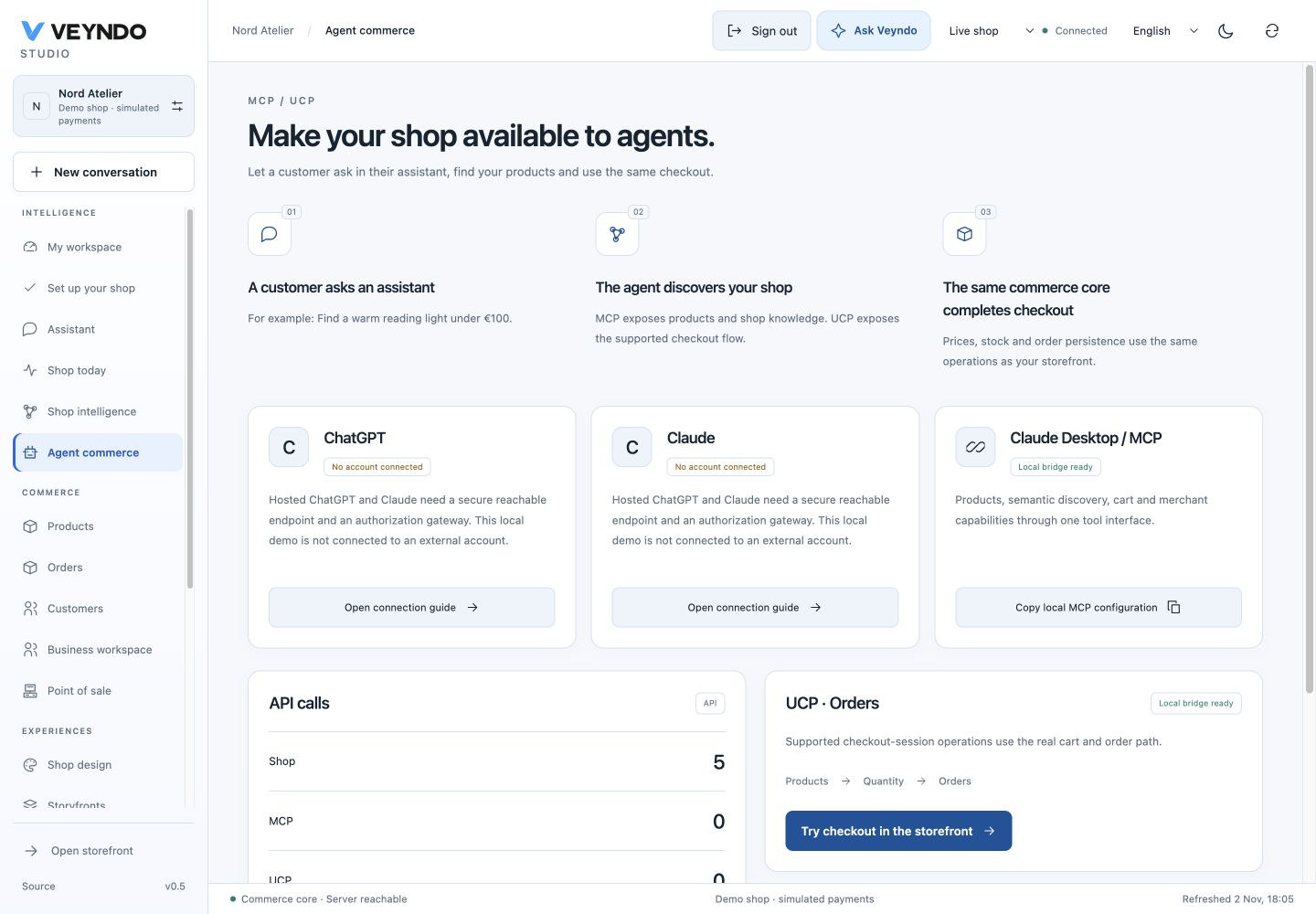
HTTP and MCP expose the same native operations. Implemented UCP checkout and B2B negotiation routes reuse carts, quotes and orders. Connect Claude Desktop and authorized ChatGPT/Claude remote clients; develop with Codex and Claude Code.
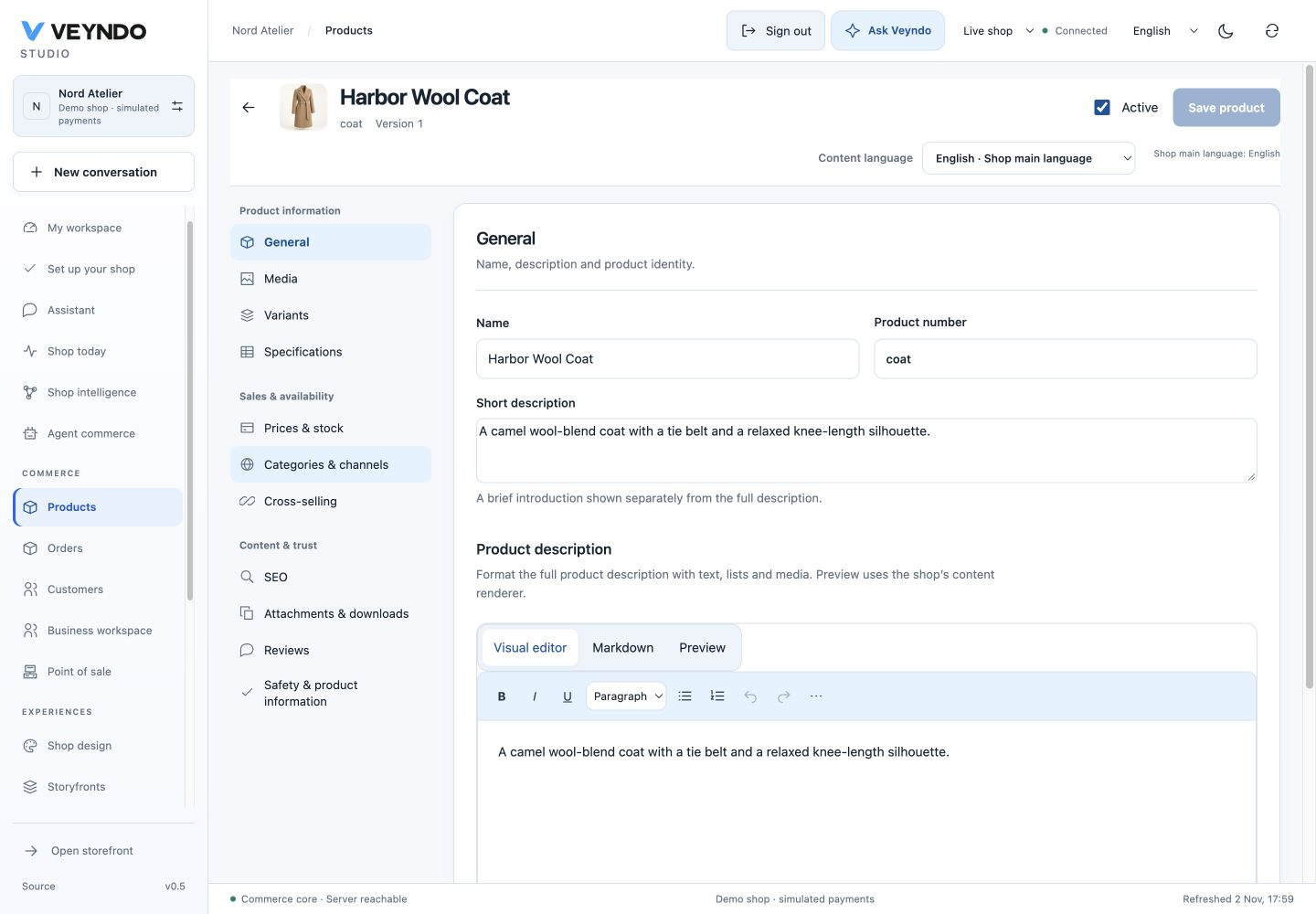
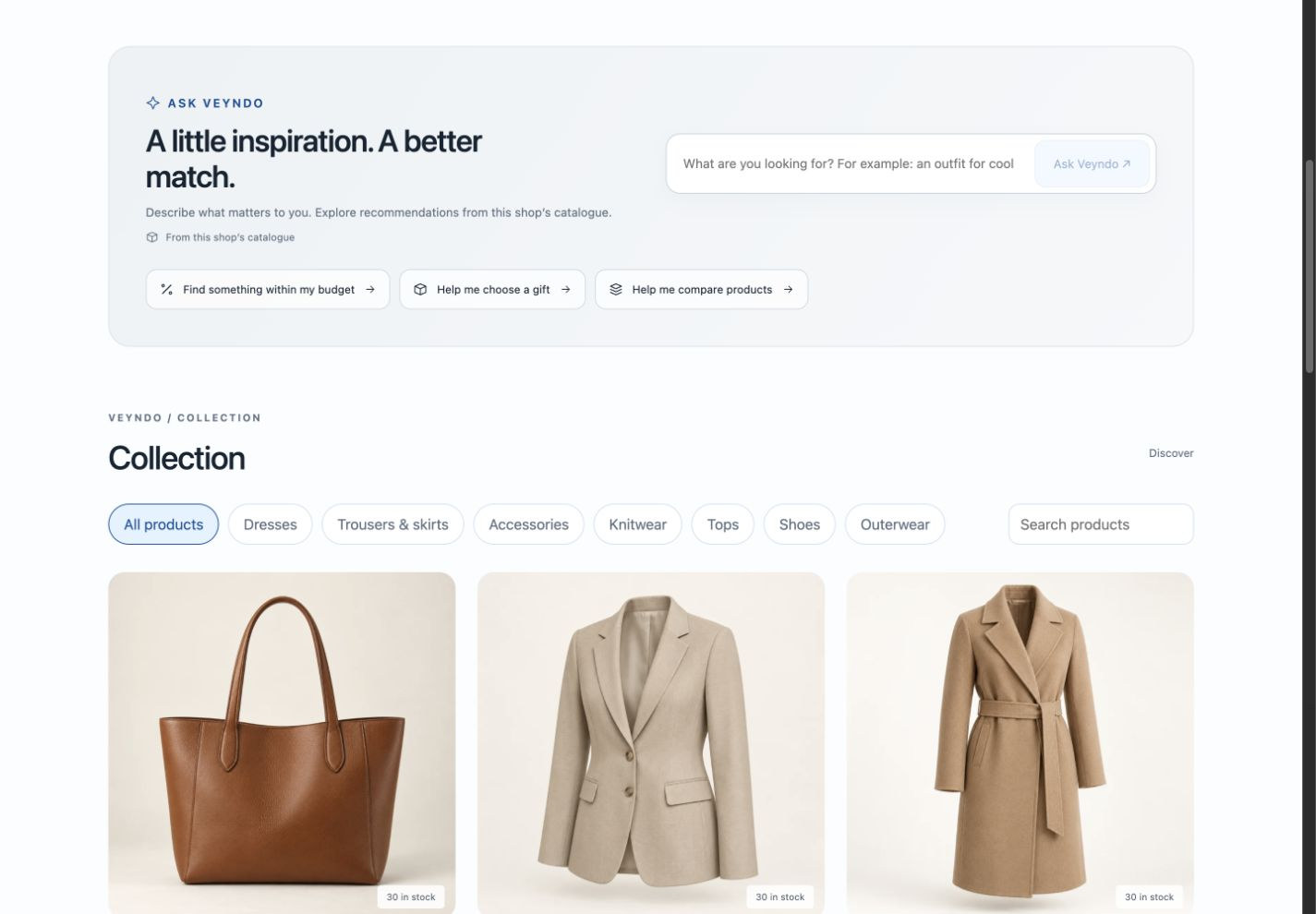
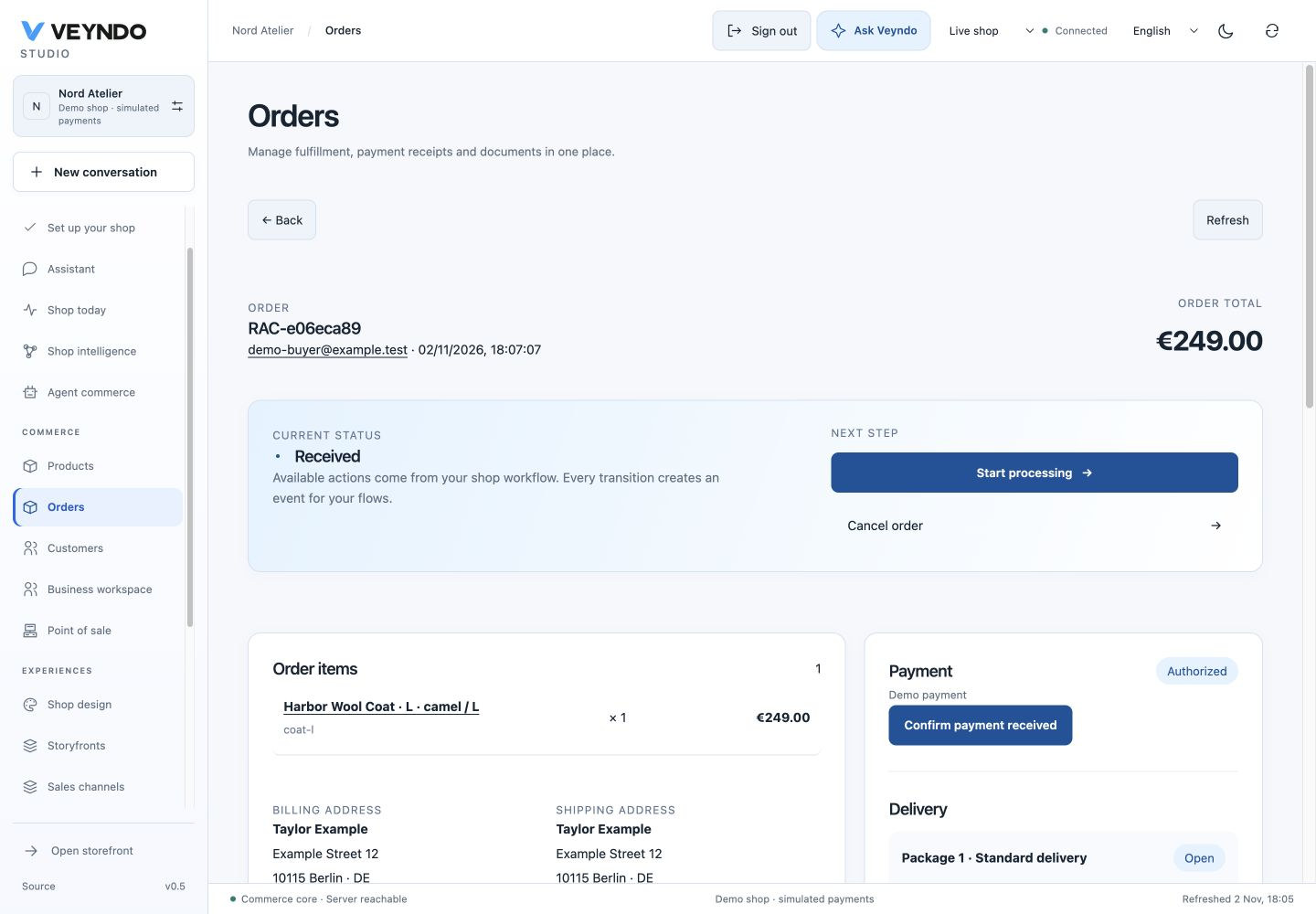
Keep Ask Veyndo beside your work. Ask product questions, open the matching editor or request a product list, details and catalogue intake together. The agent composes registered native components through OpenUI with real authorized data. Open the original editor, import a CSV privately and pin the working view for your next visit.
Rust commerce and standard connector services. PostgreSQL transactions and durable events. Rebuildable semantic retrieval and bounded Wasm hooks. Prices, stock, orders and permissions remain in their native owners.
Our ambition: the most advanced publicly developed commerce platform for the AI era. Read the source, self-host and adapt it under the Sustainable Use License.
ONE USEFUL ROUND
Change it privately. Publish deliberately.
Start a synthetic local shop, edit a product in its sandbox, inspect the difference and publish only that change. No model download or provider key is needed for this first round.
1. Try the connected workflow
Follow the short hands-on guide. Local orders and accounts survive a restart.
COMMERCE, FROM THE CORE UPRust/PostgreSQL/Wasm apps/MCP + UCP/Local LLMs
Connected merchant workflows · 29 October 2026
One commerce core. Connected intelligence.
Ask an agent for a working view, create a private app from a description and
shape the shop around real products. Review saved-data compatibility before
installing an app upgrade. Let fictional customers try a private change,
inspect their steps and decide what to publish.
Give one to six fictional customers a shopping goal, budget and language. Compare saved runs, inspect stock or checkout failures and open their native private test orders.
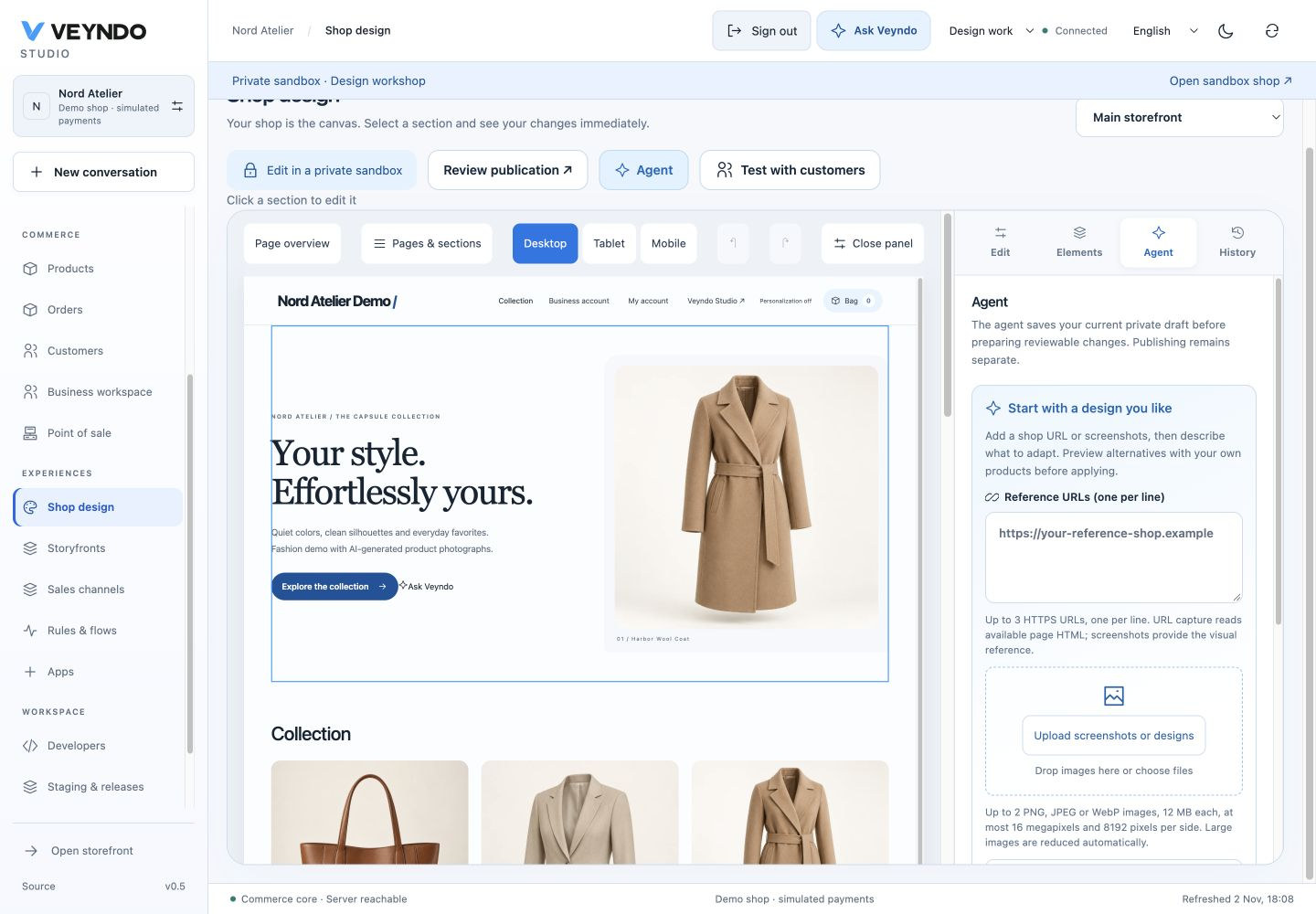
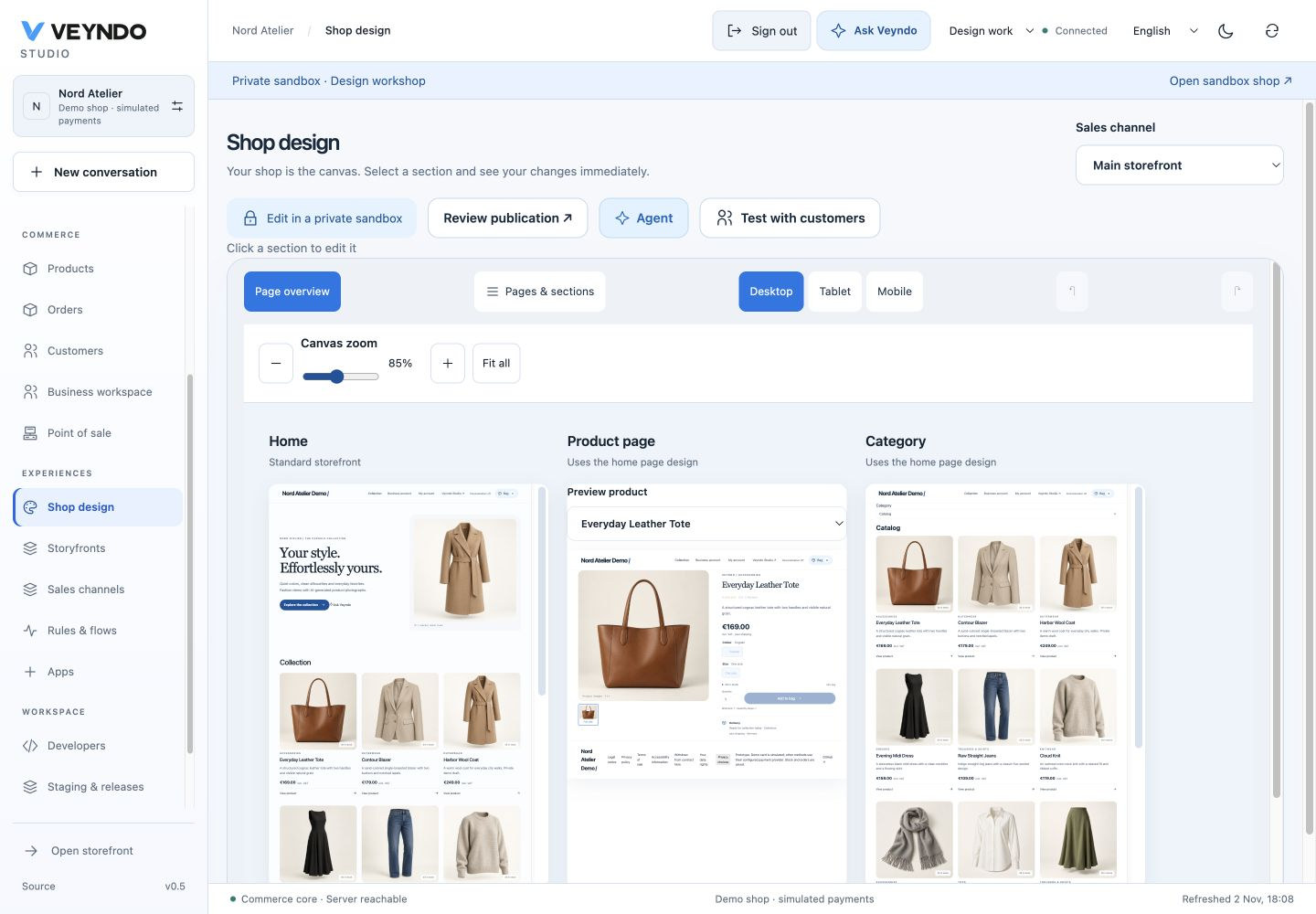
Drag illustrated components into the actual preview. Work on a selected section or compare reference-based style proposals on desktop and mobile. Save the approved result as a private revision.
Inspect stored record counts, required migrations, saved examples and active Flow or payment consumers. The native installation check rolls its trial back and reports what needs attention.
Actual native Studio captures from 2 November 2026. English subtitles, no sound. Follow the shared canvas, product work, a product advisor app and contextual AI.
AI across the working shop
1:56 · English · Silent
Merchant intake, reviewed shop knowledge, design references, the shared canvas, app assistance and fictional customer scenarios.
Earlier workflow recordings, captured 13 October 2026
Earlier tours · 13 October 2026
One core. More possibilities.
Three earlier connected tours, retained with their original capture date. Actual UI, readable English captions and no sound. Choose a tour or jump to a chapter.
Real application recordings1080p · English captionsLocal synthetic shops
CONNECTED COMMERCE0:38 · Actual UI
POS → shared native order · Company → unit → budget
Shared orders. Controlled purchasing.
One catalogue. Shared orders. Controlled business purchasing.
Editorial sequence of fresh actual UI stills. An app draft version, an unsaved Flow edit and a selected product release are shown as distinct operations.
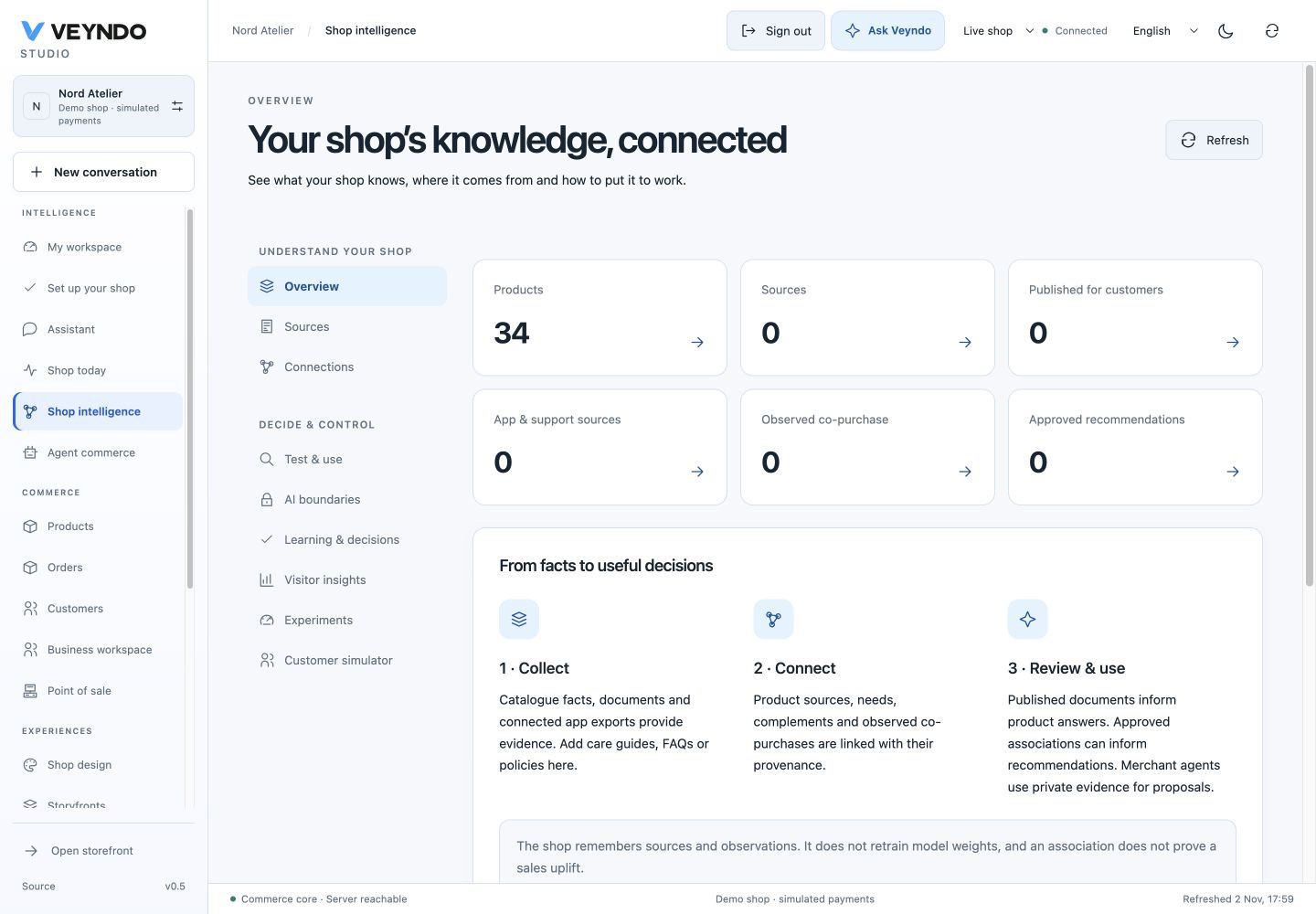
Actual UI screencast of reviewed synthetic knowledge and explicit autonomy limits. No continuous business optimization or model training is demonstrated.
The product. In motion.
See what you can actually build.
A fashion shop. A visual app builder. Knowledge, flows and controlled
releases. Six real workflows, recorded inside Veyndo.
Actual product recordingsEnglish interfaceSimulated commerce
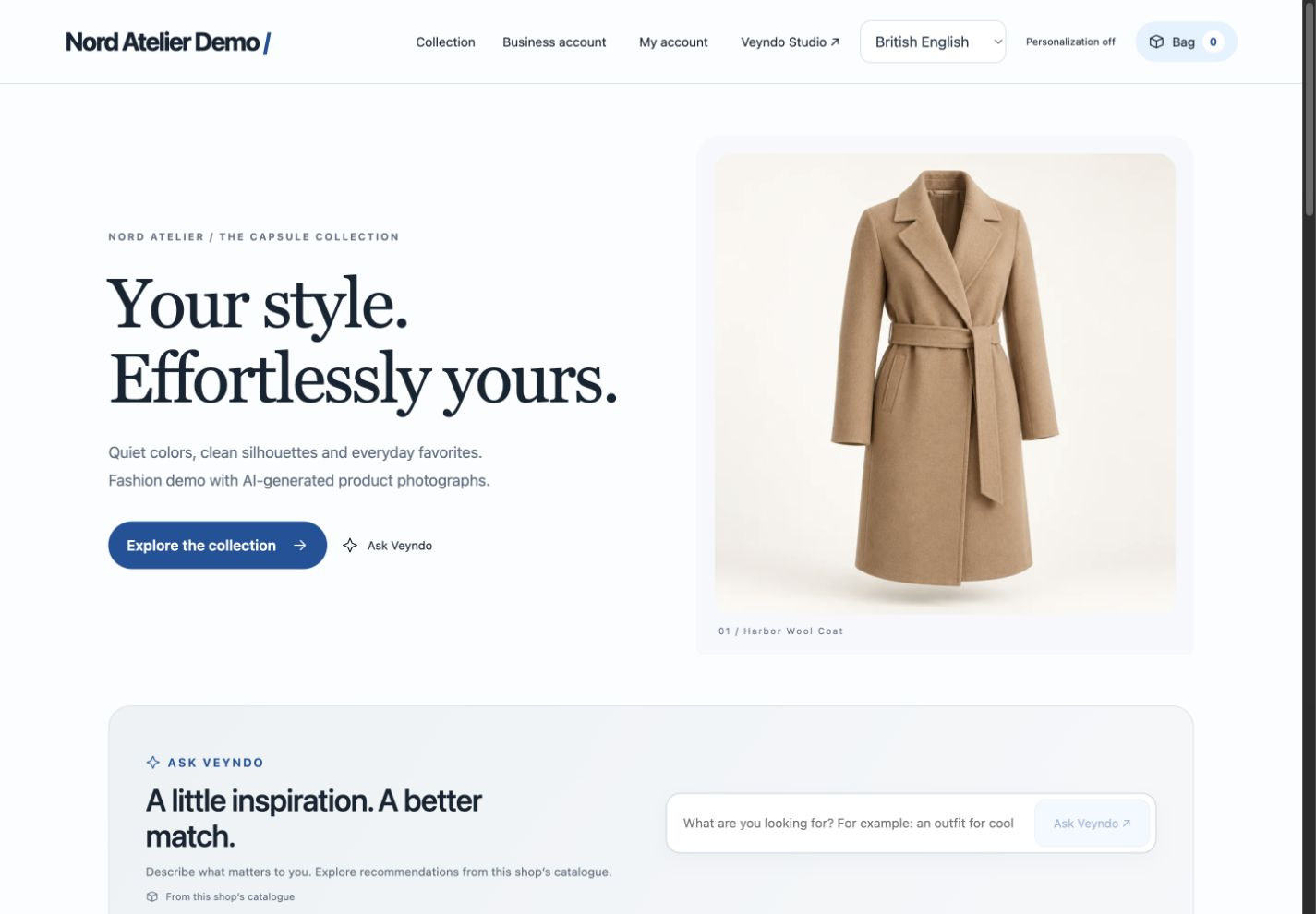
01 / SHOP & CHECKOUT25 sec · Recorded UI
Native SKU → reviewed quote → saved order
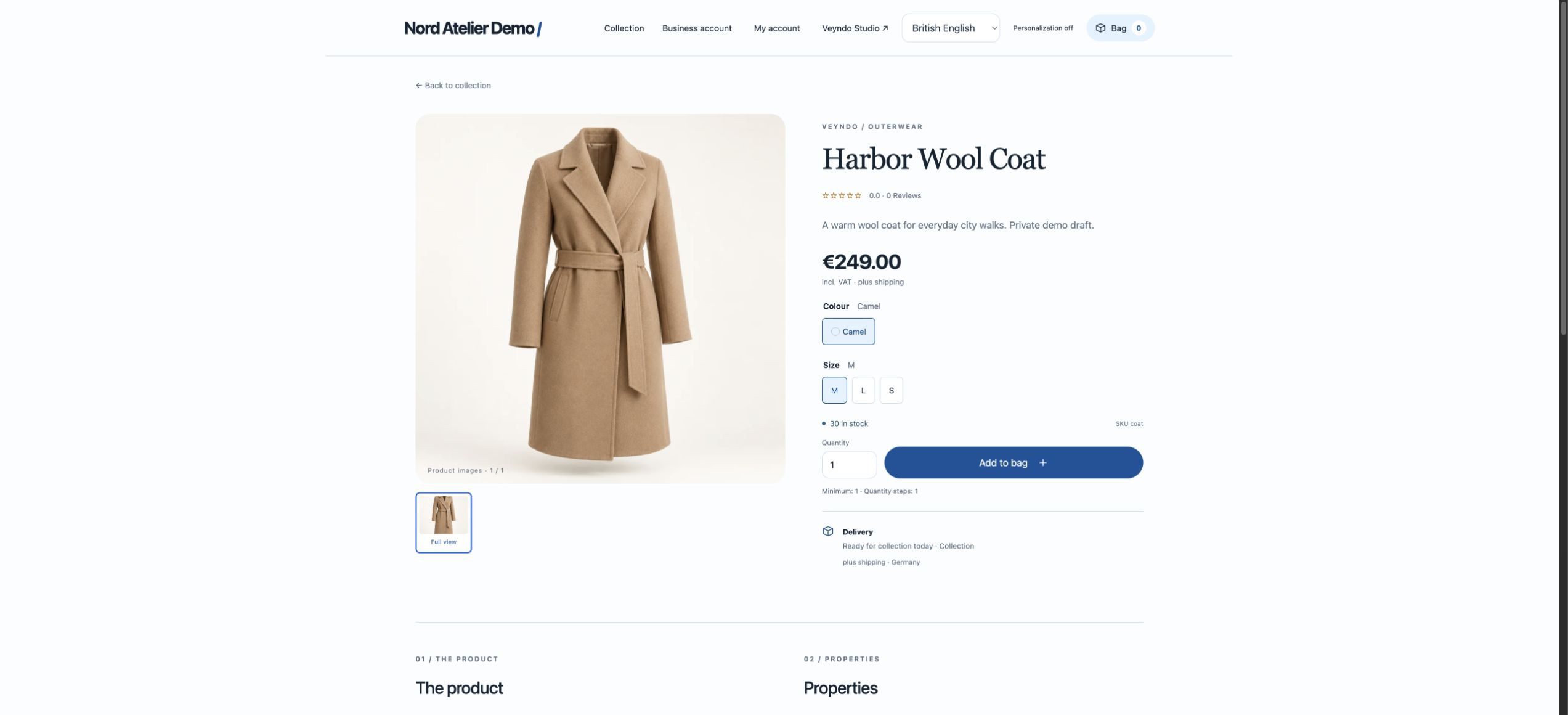
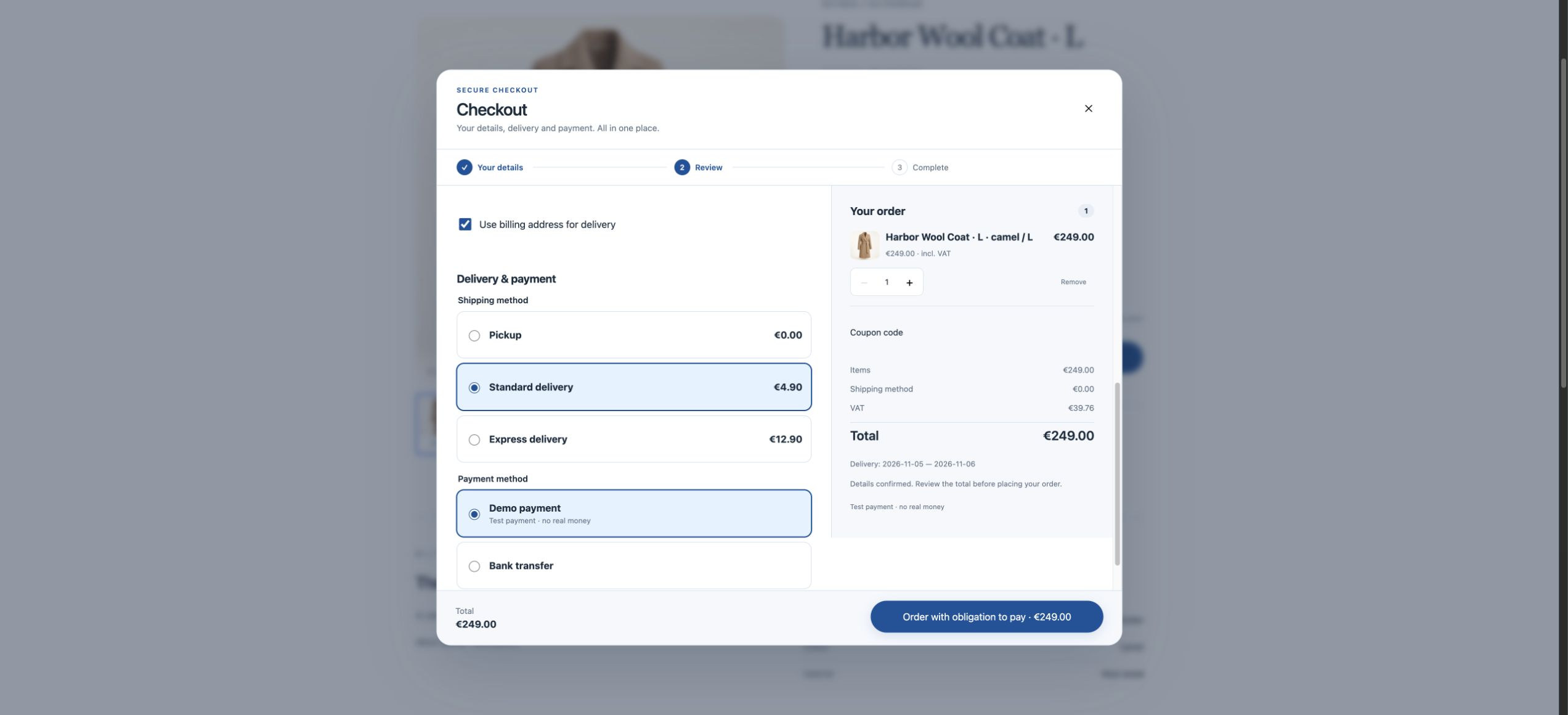
From a coat to a confirmed order.
Choose a real SKU, review the server-calculated quote and complete a
simulated order. Product, stock, checkout and order history share the
same commerce core.
Add UI blocks, inspect their properties and undo or redo your changes.
App Studio uses the versioned data, API and interface schema that
coding agents use too.
Design preview uses explicitly labelled sample data. This clip does
not show a paid coding-agent call.
03 / SHOP KNOWLEDGE50 sec · Recorded UI
Private source → publication review → public knowledge
Give your shop knowledge it can use.
Move a fictional care document through the publication decision.
Sources retain their origin and visibility; private information does
not become customer knowledge just because it was uploaded.
Native knowledge workflow; no model-training or external inference
result is claimed.
04 / FLOW BUILDER24 sec · Recorded UI
Order event → rule branch → durable actions
Branch. Wait. Act.
Explore a saved six-step order flow with conditions, two branches, a
durable delay and document generation. Native actions and declared app
capabilities live in the same graphical workspace.
Editor walkthrough. This recording does not assert external email or
Slack delivery.
05 / STAGING & RELEASE20 sec · Recorded UI
Private sandbox → selected app version → release
Ship one change. Keep the rest private.
Publish the selected versioned app package from a private sandbox.
Separate app-record data stays in staging instead of being silently
copied into the live shop.
Actual selective package release in a synthetic shop; no production
tenant was modified.
06 / MULTILINGUAL CATALOG18 sec · Recorded UI
Saved translations → one language selector → Markdown
One field. Every language.
Switch between saved product translations, then open their Markdown
source. A single content-language control keeps the product editor
focused while the shop language provides inheritance.
One million products plus one million translations in PostgreSQL. Release
build. Fixed arrivals of 500 requests/s. Every response checked.
1M PRODUCTS / 50-PRODUCT PAGE12.9ms p95
500 offered requests/s · real HTTP + PostgreSQL
20-LINE CART / 1M PRODUCTS21.4ms p95
500 offered requests/s · full validated quote
DURABLE CHECKOUT17.7ms p95
500 offered requests/s · fresh durable orders
One core. Every interface.
Give agents tools. Keep the keys.
The browser, an MCP client and UCP checkout reach the same commerce
operations. Permissions stay in the server. Follow the request, checkout,
tenant security and intelligence paths in the
illustrated architecture guide. The core hardening review
explains trusted identity, shared resource limits, transaction-local
tenant scope and recoverable event processing, including the deployment
cutover.