 Vendune
Guided apps and embedded commerce editors
App Studio starts with nine assistants: frontend, admin, combined, payment, shipping, third-party integration (ERP), event subscriber, signed incoming webhook and scheduled task. Each assistant creates an ordinary versioned Manifest, editable visually or by a coding agent. It never hides provider-specific code behind a template.
Build and try an app
- Open Developers → New app, choose a use case and its placement.
- Edit one content language at a time. Names, field labels, choice labels and view text support inherited shop languages. Built-in assistant labels ship in English, German, French and Spanish.
- Choose an independent admin module, a product-general section, a new product tab, customer/order fields, a product-detail surface or a storefront page. Choose explicit public reads and MCP exposure.
- Edit the resulting data models, choices, context bindings, routes, team scopes and automations. Select a private sandbox, save an immutable version and stage it under Versions & releases.
- In Design, open the installed sandbox preview. Select an actual product/customer/order when the app is attached to one. Save a record, reopen it and verify its revision. Release only the reviewed package; app data has a separate selective release path.
Existing apps still open through their cards and Edit app. Regeneration preserves existing action access settings for actions with the same app/action identity. New generated actions default to MCP off. External agent JSON is reviewed and validated before staging.
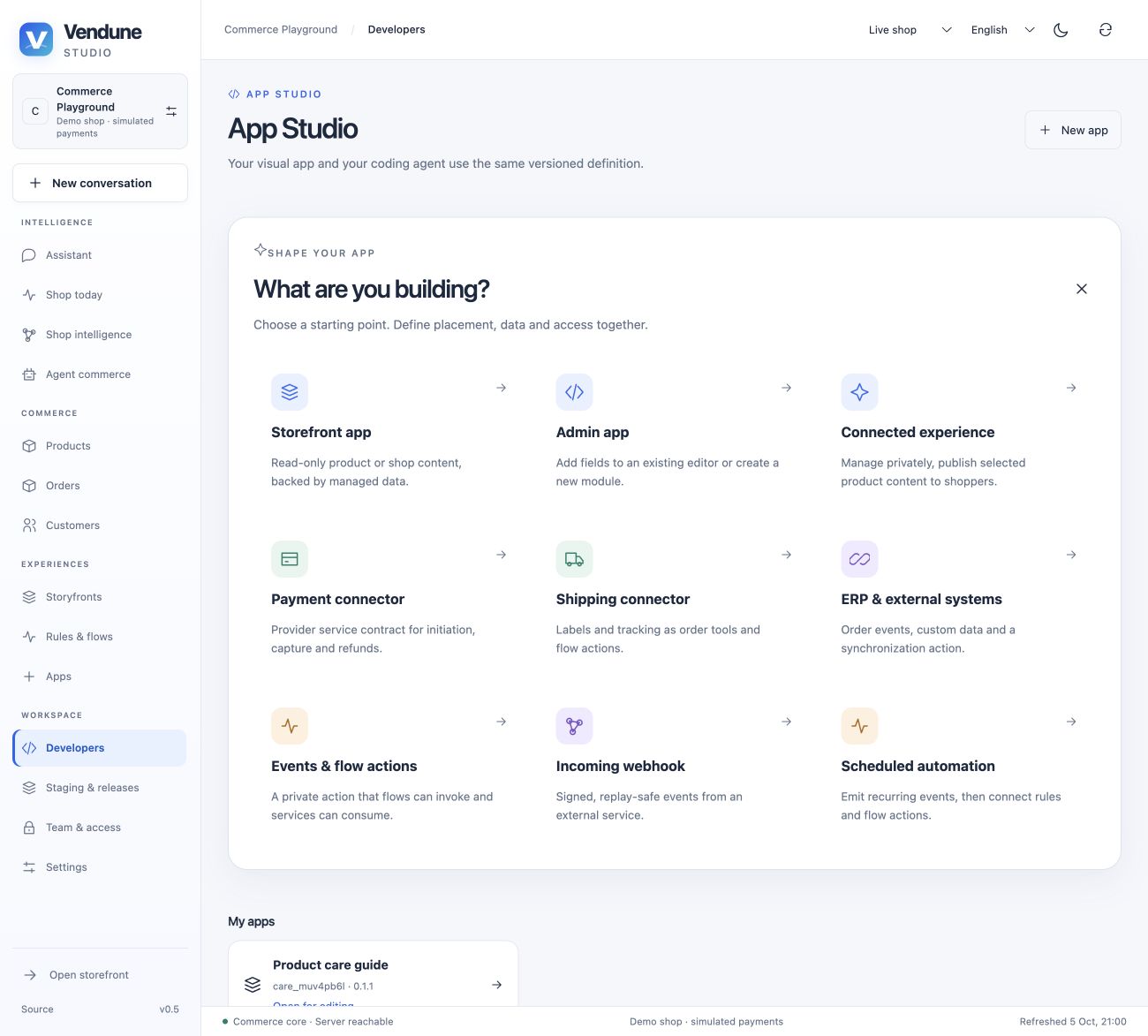
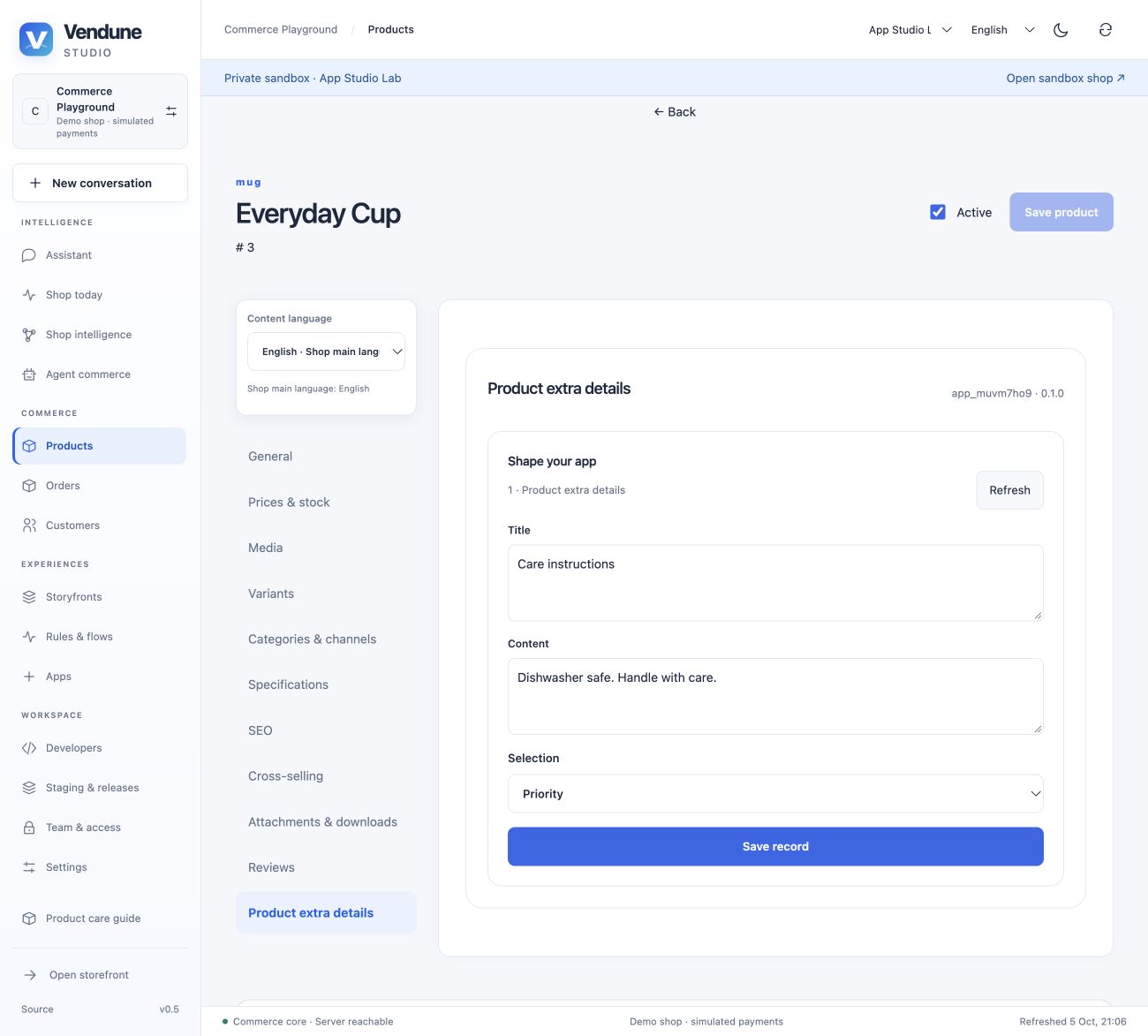
Editor extensions with actual ownership
coreReference: "product" | "customer" | "order" declares a required/indexable plain string holding an existing object's ID in the same shop. Native blocks bind that field with contextBinding: {field: "product_id", key: "productId"} (or customerId/orderId). The server validates the reference on each write. The host filters reads by its selected object. Missing context does not trigger an unfiltered read. A bound form updates the saved row with its optimistic revision; a model may also support multiple records per object through table/card blocks.
Supported editor mounts are admin.product.general, admin.product.tab, admin.product (legacy), admin.customer, admin.order and admin.order.general. Product tabs appear in the central product editor; new fields reside in app-owned tables, rather than becoming ad hoc columns on core tables. choices: [{value, label}] creates a server-validated selection field with localized labels. Public customer/order references are rejected.
Four independent access decisions
| Decision | Manifest / enforcement |
|---|---|
| Who can see/edit the admin module? | Surface permission plus per-action team permission; unreadable blocks disappear and read-only users receive cards instead of editable forms. |
| Is the data public in the storefront API? | Entity publicRead and explicit public list action; authenticated writes remain separate. |
| Can MCP discover/call this action? | Action mcp flag plus the same team authorization. Omitted mcp retains legacy behavior; new assistants default false. |
| Can merchant AI use this action as a selected planning tool? | intelligence.tools selection and action authorization; independent of MCP exposure. |
The legacy direct entity routes also enforce the matching action scopes. Merchant planning filters app grounding/actions by current rights and rechecks selected actions both when binding a proposal and when committing it; a model cannot invent a disabled tool to bypass the gateway. UI visibility alone grants no backend access. Do not put secrets into records, prompts or manifests.
Events, cron and incoming webhooks
Event subscribers use the existing durable app event worker. Flow-enabled actions appear in the graphical Flow Builder. Emitted app events use app.APP_ID.ACTION; flow rules can inspect their payload. Service calls use the configured operator service, bearer secret, deadline and per-process resource bulkheads.
Schedules declare id, six-field UTC cron, a declared emit action, typed input and enabled. They support at most eight jobs per app; seconds must be a single number, bounding execution to once per minute per schedule. Existing worker processes claim due rows transactionally with SKIP LOCKED. The schedule tick and outbox event commit together; duplicate ticks are prevented across restarts/replicas. Missed ticks coalesce; native private sandboxes never execute schedules. This does not promise exactly-once external effects: consumers remain at-least-once and must use stable idempotency keys.
Incoming webhooks use POST /webhooks/apps/TENANT/APP/WEBHOOK. The operator sets server-only APP_WEBHOOK_KEYS as { "tenant": { "app": "secret of at least 32 bytes" } }. Headers are x-app-timestamp (Unix seconds within five minutes), x-app-event-id (bounded stable ASCII identifier) and x-app-signature (hex HMAC-SHA256). Sign the newline-separated tenant, app, webhook ID, timestamp, event ID and SHA256 hex of the exact UTF-8 JSON bytes. Bodies are bounded to 16 KiB and checked against the declared action schema. The declared action must emit. Identical repeats return the persisted event receipt; reusing an event ID for different bytes fails. Foreign-shop signatures and private-stage delivery fail. HTTPS is required when exposed outside a local trusted environment; public ingress/network hardening remains an operator deployment responsibility.
Shopware extension requirements reviewed
Reviewed on 2026-10-05 against Shopware's curated Most Popular Integrations (24 entries at review time) and integration catalogue. This is a requirements sample, not a verified ranking of installations. Shopware documents app Flow actions and plugin Flow actions separately. Vendune's capability mapping below is an architectural assessment, not a claim of those apps' complete behavioral equivalence.
| Representative apps | Needed behavior | Vendune support / boundary |
|---|---|---|
| PayPal, Mollie, Stripe, Adyen, Klarna, Amazon Pay | Payment initiation, capture/refund, callbacks, account credentials | Payment service assistant provides typed action contracts and native settings. Existing payment hooks connect checkout. Provider onboarding, signatures, disputes and reconciliation need provider implementation/tests. |
| Pickware ERP/WMS/POS | Product/customer/order mappings, owned extension data, synchronization and reconciliation | App-owned models, scoped core references, private editor fields, routes, events, schedules and isolated services. Arbitrary core schema mutation and full POS/offline workflow are not supplied by the assistant. |
| Sendcloud | Shipment creation, label/tracking API, order UI, callbacks | Shipping service template plus order mounts, action rights, events/webhooks. Actual label/provider handling remains custom service code. |
| magnalister, Channable | Marketplace/feed export, mapping, queued updates | Managed mappings, catalog APIs, event subscriptions and cron emit tasks driving service consumers. Bulk feed pipelines and marketplace authentication are app implementations. |
| Klaviyo, Brevo, CleverReach | Marketing event/customer sync and consent-aware segmentation | Customer choice fields, private context, event/Flow service calls. Provider-specific consent semantics and campaign workflows must be implemented and verified. |
| Trusted Shops | Review/trust widgets and order follow-up | Public cards or sandboxed custom UI, scoped order events and service calls. Arbitrary native JSX injection is not permitted. |
| Usercentrics / Cookiebot | Consent UI and control of trackers | Existing consent-aware storefront integration plus custom app UI. Assistant fields alone do not intercept every third-party tracker. |
The shared representation supports the recurring requirements above without a new extension protocol for each provider. The native editor has four block kinds. Custom scripts, sophisticated widgets, long-running external jobs and provider algorithms use the isolated app-service/UI SDK path. Self-service deployment of arbitrary server code is not implemented by these assistants. Service endpoints/credentials remain operator configured.
Source and verification
frontend/src/admin/developer/assistant-model.ts: assistant Manifest construction; other App*.tsx modules own UI editors.src/apps/editor_contract.rs, data.rs, surfaces.rs: owned reference, choice, scope and context enforcement.src/apps/schedules.rs, webhooks.rs; migration 036: persistent clock ticks and signed deduplicated ingress.src/apps/gateway.rs,src/mcp.rs: independent tool exposure and real action authorization.extensions/apps/assistant-examples/: twelve installable contracts for nine types and additional product/customer/order placements.scripts/app_assistants.py: actual PostgreSQL/HTTP import, stage, private data, scoped rights, public/MCP boundaries, local service call, signed webhook→rule→Flow→saved record, concurrent replay, cron and cold restart.- Frontend unit tests exercise wizard compilation, rights controls, missing-context prevention and hydrated revision-bound fields. Rust tests reject invalid manifests and signatures. Lean covers only two extracted pure access decisions with production bindings, not the browser, scheduler, provider service or async database behavior.