 Vendune
Company identity, legal metadata and channel inheritance
Vendune Studio → Settings → Company details owns a company's factual identity, structured address, contact and bank details, public brand text and logo. The scope selector chooses the shared company basis or a configured sales channel. Storefront and headless channels use the same resolver. Separate SaaS tenants never inherit from each other.
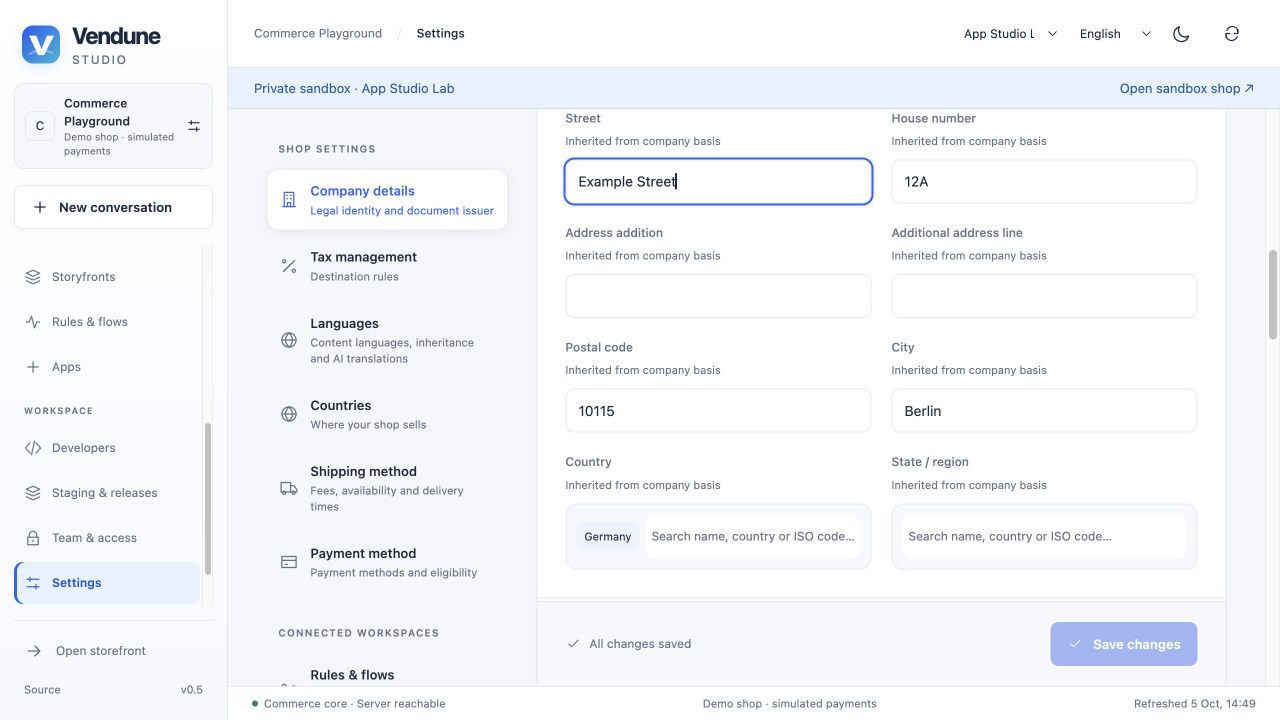
Identity and address
name is the statutory company name. Address fields are street, houseNumber,
additionalAddressLine1, additionalAddressLine2, postalCode, city, country
and countryStateId. The searchable world/subdivision pickers use the tenant's
country catalogue, including custom countries and regions. A company's country
need not be enabled as a delivery destination. Structured addresses require a
city and valid country; a subdivision must belong to that country.
Legacy address remains readable and is preserved verbatim until a structured
street is supplied. The server then derives address from the individual fields
for compatibility and document printing. It never guesses how to split an old
address. House numbers and postal codes are strings, preserving 12A, leading
zeroes and international postal formats.
Legal metadata includes legalForm, registerType, registrationNumber,
registerCourt, managingDirectors, legalRepresentatives, contentResponsible,
contentResponsibleAddress, vatId, economicId, supervisoryAuthority,
professionalChamber, professionalTitle, professionalCountry,
professionalRulesUrl, shareCapital, outstandingCapital and
liquidationNotice. Contact fields are email, phoneNumber, website;
internal document fields include taxId, bankName, iban, bic.
The field selection follows the conditional information categories of § 5 DDG and the content responsibility provisions of § 18 MStV. These are optional fields because applicability differs by entity, activity and jurisdiction. Their presence does not validate register entries, VAT numbers, invoice compliance or the completeness of a shop's legal disclosures.
Inheritance and translation
- Missing or
nullchannel fields inherit from the shared basis. - A string override replaces only that field;
""explicitly clears an optional field, including suppressing a logo withlogoId: "". - The restore control writes
null; editing an inherited field creates a local override without copying other basis fields into the channel. brandName,legalNoticeandresponsibilityScopeare locale maps. Channel locale entries merge over basis entries; missing/null entries inherit. The resolved map falls back per field to the shop'smainLocale. Empty text stays empty. The editor uses one enabled content language and never generates fictional translations when the language/scope changes.- Statutory names, addresses, people, identifiers and bank numbers are factual values, not machine-translated legal identities. Interface labels ship in English, German, Spanish and French.
For example, the basis can contain one seller/address/logo while a second brand
changes only brandName.de, email and logoId. A different legal seller may
also override name, address and register details. Tax, shipping and payment
configuration has its own shared basis and sparse channel overrides; see
settings scopes. Company
identity overrides do not silently change tax calculation or provider accounts.
Other domains should adopt explicitly typed override contracts and connect their
actual consumers; a generic JSON settings bag is insufficient for those rules.
HTTP and MCP contracts
| Endpoint | Purpose |
|---|---|
GET/PUT /api/settings/master-data |
Shared {data, revision} company basis |
GET/PUT /api/settings/master-data/channels/{id} |
Sparse {data, revision, baseRevision, inherited, effective} channel contract |
GET/PUT /api/merchant/receipts/settings |
Compatible alias for the same shared record, retaining document ACL |
POST /api/settings/company-logo |
Multipart file; validated private upload |
GET /api/settings/company-logo/{id} |
Settings-reader private JSON/data-URL preview |
GET /store-api/company |
Resolved public identity for x-tenant and sw-sales-channel-id; localized by x-commerce-locale |
GET /store-api/company-logo/{id}?shop=…&channel=… |
PNG bytes only for a logo currently linked to that public channel |
MCP merchant.company / merchant.company.save |
Same read/save functions, optionally scoped with channelId |
Writes require settings.write, reads require settings.read; company MCP tools
use the same tenant admission and permissions. Channel writes require both the
observed override revision and basis revision. Stale writes return 409 and leave
the client draft intact. Basis changes also validate all resulting dependent
channel addresses. The main default channel and additional channels inherit the shared basis
until explicitly overridden; each has an independent sparse override record. Each update emits
settings.master_data_changed through the normal outbox.
Logo and public identity
Images are decoded with size/allocation limits, stripped of embedded metadata and
normalized to PNG. Only PNG, JPEG and WebP are accepted, up to 2 MiB input/output
and 4096×4096 pixels; SVG, malformed/truncated images and foreign logo IDs are
rejected. Immutable bytes live in company_logos with a SHA-256 digest; at most
50 distinct uploads are retained per tenant. Uploads remain private until their
ID is saved into an effective company profile. Removing a logo unlinks it from
public delivery; stored bytes remain for identity history and reuse. A private
sandbox remains private even when an image URL supplies its shop query parameter.
Storefront navigation/footer use the effective brand/logo. #legal is directly
reachable from the footer and renders the explicit public projection. Domestic
tax number, bank details and arbitrary internal fields are not included. The
receipt issuer is resolved from the order's stored salesChannelId inside the
issuance transaction. Seller/address/register/representative/VAT data are frozen
in the document snapshot. Cancellation reuses the original invoice's seller.
The current PDF renderer prints text; logo bytes are not embedded in PDF output.
Staging and implementation
A private environment clones the basis, overrides and immutable logo bytes.
company and company-channel:{id} are independent selectable release units.
Releases check stage digest and the live baseline, copy only the selected logo,
resolve duplicate image digests to owned live IDs, validate the final company
aggregate and emit an event atomically. The baseline records canonical published
IDs, so subsequent releases continue to compare against actual live state.
| File | Responsibility |
|---|---|
src/operations/company_model.rs |
Field whitelist, locale/country validation, sparse inheritance, address projection |
src/operations/master_data.rs |
Shared/channel persistence, revision/transaction boundaries and issuer resolution |
src/operations/company_logo.rs |
Decoder limits, immutable storage, authenticated preview and linked public bytes |
src/operations/company_public.rs |
Deliberate public projection without private banking/tax fields |
src/staging/company.rs |
Selective company/override/logo release and canonical baseline |
frontend/src/admin/settings/Company*.tsx |
Modular factual fields, logo, content-language editor |
frontend/src/storefront/shell/CompanyLegalPage.tsx |
Public channel legal view |
migrations/030-company-settings.sql |
Tenant/channel foreign keys, revisioned overrides and logo storage |
Verification boundary
scripts/company_settings.py runs real HTTP/PostgreSQL checks for structured and
legacy addresses, tenant/custom subdivision validation, sparse two-channel and
Spanish-main-language inheritance, stale versions, concurrent writers, logo
admission/private publication, foreign IDs, channel checkout/issuer PDF,
immutable cancellation, MCP, private cloning and repeated selective releases
with digest deduplication. It is registered in the normal CI HTTP suite registry.
frontend/tests/unit/company-settings.test.tsx covers real sparse saves,
restore/scope-discard behavior, dynamic enabled languages, independent channel
and language fallback, and upload admission. Existing merchant operations,
customer account and staging suites continue to run. Rust unit tests exercise
address inheritance and decoded image admission.
The existing Lean policy suite, source review locks and negative mutation checks remain mandatory. These new JSON/SQL/image/UI adapters are explicitly unproved; green tests and reviewed hashes do not certify legal compliance or the whole core.
Channel settings and media workspaces (2026-10-05)
See the settings/media guide for the current single-language editor, field-level checkout overrides, dependency-safe method removal, gallery and optional private image jobs. These are native prototype extensions; they do not establish additional full Shopware API/DAL parity, current tax law, paid-provider quality or whole-system formal certification.