 Vendune
Visual App Studio
App Studio and coding agents edit one Manifest. The same renderer, action gateway, permissions and model schema power private previews and published apps. Open Studio → Developers; choose a guided app type or click an existing app's Edit card.
The development loop
- Choose a frontend/admin/combined/payment/shipping/integration/event/cron app assistant. It creates normal entities, actions and surfaces, not a hidden blueprint.
- In Design, use a 12-column form raster. Drag controls from the toolbox, snap positions, resize by handles, use Ctrl/Command for multi-selection and align or distribute selected controls. Narrow screens render the same layout as a stack.
- Press F4 for properties: translated caption/tooltip, geometry, visibility, enablement, tab order, model/field/context binding. Geometry properties can be sorted alphabetically or by their defined category. Tab-order mode assigns order by clicking controls. An optional Classic appearance affects the designer only.
- Double-click an input/button for code-behind. Visual instructions, BASIC and typed JSON edit the same bounded AST. Completion buttons insert current actions, form validation and refresh targets. Calls still need the surface allowlist.
- In Data models, add rich field types and validation. The relationship diagram accepts dragging a field onto a target model. Create workspace from model adds a grid, linked record form and a validated save button.
- Press F5 for a private one-hour preview. It creates actual actor-private app tables/records through the existing registry. Changes hot-reload after validation. No saving/staging/publishing is required to try a draft. Preview services cannot send external events, place orders or execute live payment/provider actions.
- Use the debugger to pause before instructions or at a numbered step, continue, stop and inspect bounded operation metadata. It does not log customer records or credentials. This debugger controls UI instructions, not a remote process.
- Save an immutable semantic version, review and install it in staging, then release the selected app package. App records require their own explicit release selection.
Server drafts autosave after 500 ms with optimistic revisions. They are private to the actor and shop, restored before edits and bounded to twenty drafts/user and 64 KiB/draft. Unsaved or failed saves retain a before-unload warning. Ctrl/Command+Z uses manifest undo/redo; F4/F5 use the same controls as the toolbar. Immutable saved versions and recoverable App Studio trash are separate from autosaved drafts.
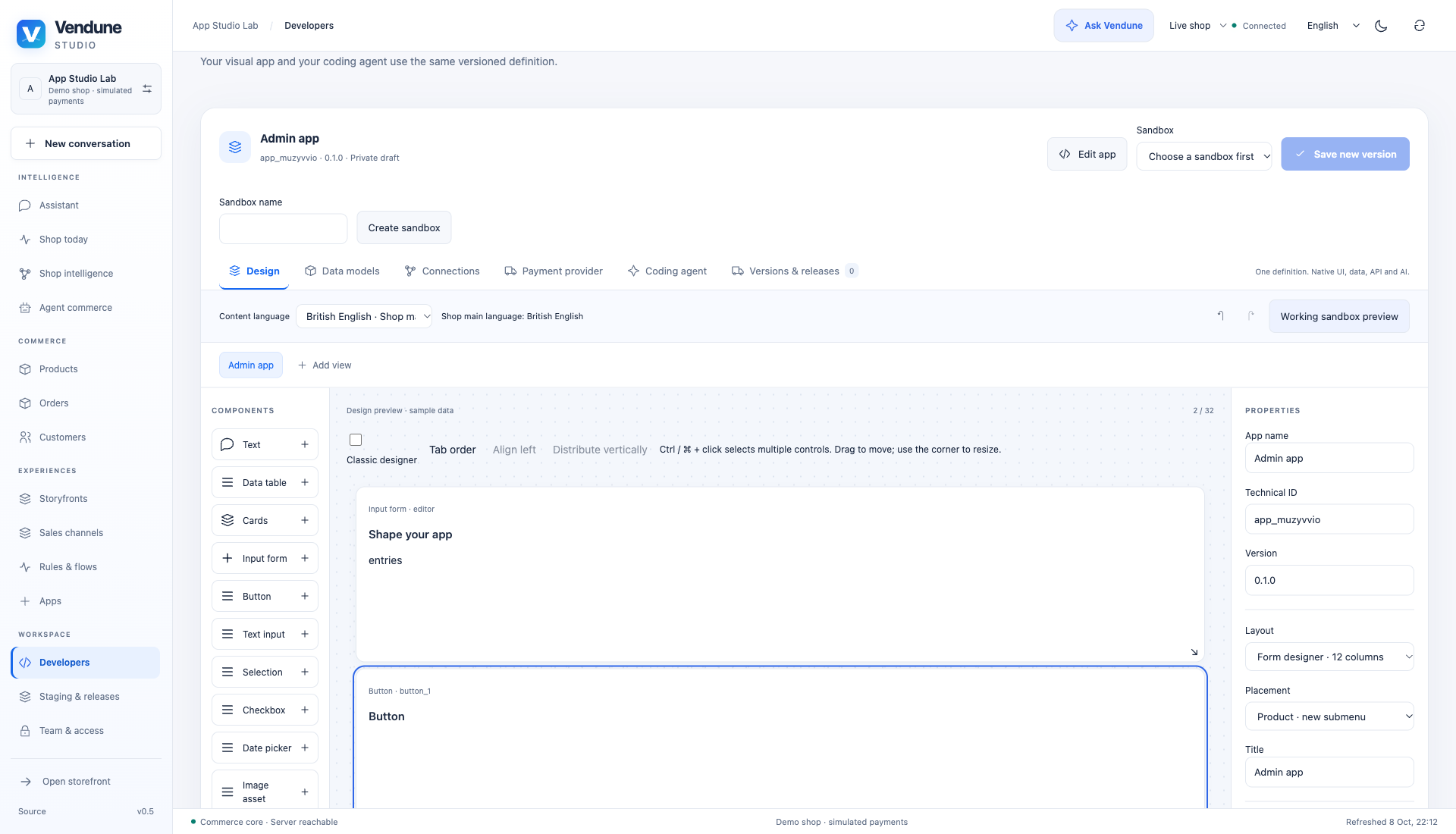
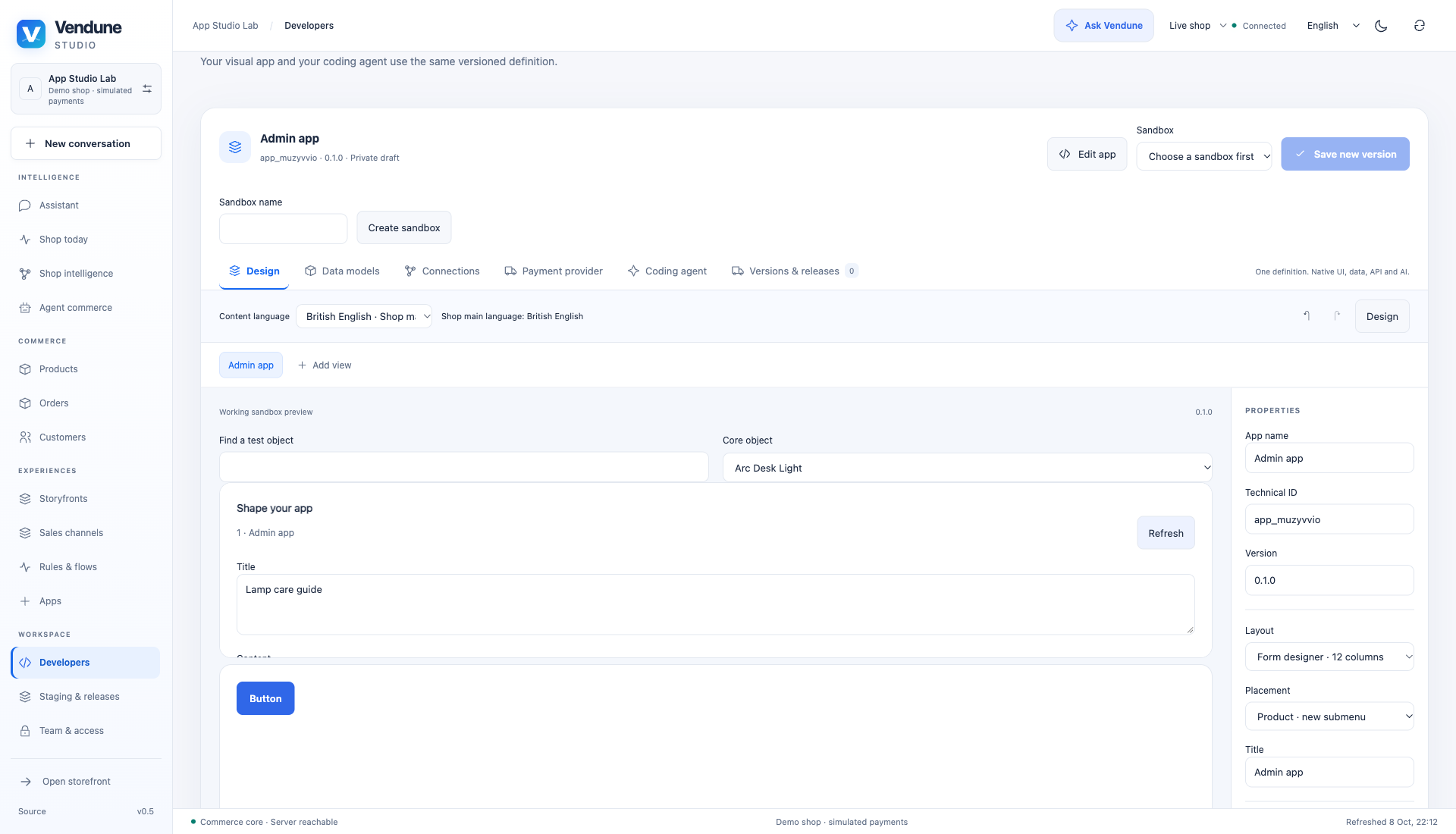
These 8 October captures use the actual browser, Rust gateway and isolated PostgreSQL instance; see capture provenance.
Controls and behavior
Text, TextBox, ComboBox, CheckBox, DatePicker, Button, table/cards/form, Image, Frame/Tabs, KPI and Chart are host-native controls. Tables can enable inline record editing with real optimistic revisions. Image/file fields use the searchable asset picker and private preview; uploads are available in product-bound editors. Timers are persistent UTC Schedules, not uncontrolled browser loops.
The AST has Set, typed If, Call, translated MsgBox, Navigate, Refresh
and Validate. It is loop-free, bounded in depth/count and independently validated
by Rust against current blocks/actions/model fields. It is not JavaScript eval,
VBA or an unrestricted scripting language. BASIC source is a convenient encoding of
that AST; structured object expressions use the visual/JSON editor.
Validate guide_form
Call save_guides(guide_form.Record)
guide_grid.Refresh
MsgBox {"en":"Saved","de":"Gespeichert","fr":"Enregistré","es":"Guardado"}
The Menus & surfaces editor reuses views in Studio navigation or existing product/customer/order editors. Each mount has one translated label, its team permission and explicit allowed actions. Public mounts allow only public reads.
Server modules edits typed WIT component source and the four commerce hooks. Components read bounded immutable cart/product/app-record snapshots, with no network or SQL imports. Source must implement the published ABI; invalid components fail before installation. The snapshot-pricing example provides executable source. The browser does not compile arbitrary PHP/Rust, deploy an external service or launch Codex/Claude shell commands. Those use the existing external app/development task path.
Shared contract and translation
flowchart TD
  Visual[Visual controls / properties / logic] --> M[Manifest]
  Coding[Coding agent / JSON import] --> M
  M --> V[Server validation and consent]
  V --> P[Actor-private F5 registry]
  V --> B[Immutable build and staging]
  P --> R[Native renderer and surface gateway]
  B --> R
  R --> D[Typed tenant app records / existing core callbacks]
The dynamic generation schema is fixtures/app-studio-schema.json, exposed by
GET /api/developer/schema and MCP developer.task. Rust specializes text maps
using every enabled shop language. One selected content language edits captions,
fields, menus and messages; missing translations inherit the shop main language.
OpenAI strict fixed-object wire schemas encode dynamic JSON as a string, restore
it on the server and then run domain validation; Claude/local adapters preserve
native JSON. This adaptation does not bypass the shared manifest contract.
For Codex or Claude Code, export a credential-free development task with the current Manifest, schema, guides and MCP bridge configuration. Import the result, review permission additions and stage it through the same operations.
Limits and tests
Sixteen views, 32 blocks/view, twelve models, sixteen fields/model and 24 actions/ routes keep previews and parsing bounded. Per-app storage has database-enforced row/byte quotas; file quotas remain with the existing product asset owner. Schema migrations are explicit and atomic; larger/relation changes are offline. Full platform and trust boundaries, security.
Frontend regressions exercise real designer edits, undo, private autosave/conflicts,
AST calls/validation, read-only surfaces and pinned UI loading. Registered
app_studio, app_preview, app_callbacks, app_schema, app_assets, app_jobs,
app_components, app_distribution and existing staging/payment suites exercise
actual Rust/PostgreSQL paths. Browser rendering and SQL/asynchronous adapters are
not covered by the extracted Lean proofs.
Map app data into the knowledge graph
In Connections → Knowledge graph mapping, first enable AI access for a model
with a native list action. Choose the selected fields and an app-owned node type.
For product/customer/order or app-record references, optionally choose an app-owned
relationship type. The label uses the same content-language selector and inheritance
as all app fields. The coding agent edits this same intelligence.ontology manifest.
The care knowledge example demonstrates current records through API, MCP and authorized planner context. This projection retains native record revisions and tenant rights; it does not turn app text into confirmed public product claims. Deleting or renaming a draft model updates mappings; removing a field drops its mapping without silently exposing another field.