 Vendune
Connected release: changes and end-to-end acceptance
This record covers the 8–9 October hardening, app-platform and cognitive-commerce
work and the subsequent documentation/acceptance pass. Core source is
598bbec112165fcac1847797786e2ba5c606e06f; private Experience is
f970543124d669971330945f74b87e9c799a76e4, pinning original Storyfront
2087783606e5c925317bae57625256a82c16bff0. A source pin, a passing fixture and a
public deployment are distinct evidence. Historical screenshots, model examples
and performance results retain their original dates and conditions.
Current release · Changelog · Machine-readable source/CI inventory
One connected system
flowchart TD
  Entry[Storefront / Studio / API / MCP / UCP] --> Auth[Current identity, tenant, channel and rights]
  Auth --> Core[Native commerce operations]
  Core --> PG[(PostgreSQL: authoritative commerce, app data and evidence)]
  Core --> Outbox[Committed outbox and leased workers]
  Outbox --> Index[Embedding jobs and rebuildable Qdrant index]
  PG --> Search[Admitted lexical candidates and native hydration]
  Index --> Search
  Search --> Model[Bounded model context and authorized read tools]
  Model --> Fence[Recheck source, commerce and explicit preference consent]
  Fence --> Read[Answer / reviewed claim / signed public fact]
  Model --> Proposal[Revision-bound proposal and merchant approval]
  Proposal --> Core
  App[Versioned app manifest and native ontology mapping] --> Auth
  Read --> Storyfront[Private original manifest compiler and presentation adapter]
  Storyfront --> Entry
The model does not own price, stock, customer identity, permissions or payment state. PostgreSQL is authoritative; retrieval indexes can be rebuilt. The private presentation adapter delegates shopping and checkout to Core. There is no second commerce implementation, independent app knowledge database or replacement queue.
Runtime, identity and database changes
The eighteen-point core repair now uses a typed request Principal, declared route/method rights and one current identity/grant query. Caller-supplied identity headers cannot become merchant authority. Unknown API routes deny access. Persistent login backoff survives another replica. Only admitted shops receive tenant buckets; random tenant names cannot exhaust a map of real-shop budgets. Native scripts use a strict CSP, and production startup checks its validated role/provider/proxy configuration.
Database deployment separates migration credentials from a non-owner, non-bypass serving role. Forced RLS, scoped operations and composite tenant references protect native and managed app tables; trusted system operations and database administrators retain privileged authority. Transaction-local context supports real transaction-mode PgBouncer. Fleet leases budget connections and API/model/app work across processes; losing the lease stops the process.
Wasm compilation uses a bounded cache, single-flight compilation and blocking work permits; compilation is moved out of commerce locks. Image decoding runs outside async request executors. Existing fuel, stack, memory and table limits remain. Commit notifications wake the existing durable workers; polling remains recovery for missed hints. Per-event savepoints prevent a poison outbox event from rolling back healthy neighbors; attempts, quarantine, explicit recovery and bounded retention persist in PostgreSQL.
Request performance additionally reuses a current request admission snapshot, skips identity SQL for native public assets, serves compressed build variants with correct negotiation, borrows decoded settings, batches sorted inventory work and limits dashboard fan-out. The recorded 9,000-request comparison has unchanged business fingerprints; it is not a universal speed-up claim.
Apps and visual development
The app platform uses an immutable manifest, exact review digest and explicit permission consent. Tenant/app/model-specific tables avoid schema collisions. Server validation enforces types, bounded nested inputs, references, uniqueness, indexed cursor lists and record revisions. Small explicit schema migrations validate records before atomic installation and keep recovery snapshots; large/relation migrations require an offline plan.
Native views, existing product/customer/order editor mounts, storefront surfaces, API/MCP actions and Flow steps share the gateway. Short surface grants bind actor, package, allowed actions and context IDs. Scoped callback keys expire and intersect the creator's current rights. Approved service digests prevent a merchant app ID from inheriting operator provider authority. Private media uses the existing asset owner. Event payloads follow granular subscription and PII grants; bounded lanes, batches, leases, retries and replay remove the former single slow global lane. Long jobs, publisher/dependency admission and bounded pure WIT commerce hooks reuse existing jobs, outbox and native calculation owners. Custom iframes remain a restricted extension boundary, not a proven hostile-code microVM platform.
App Studio and coding agents edit the same contract. Optional
intelligence.ontology maps a bounded selection of real app fields and native
references into namespaced nodes/edges. API, MCP and planner tools receive only
currently admitted projections and revisions. Model/field deletion prunes the
mapping. The ontology-care example
shows translated care advice attached to products without moving app logic into
Core. Ontology projection does not establish global graph traversal or turn
unstructured app text into reviewed product evidence.
Intelligence, evidence and safe actions
Cognitive commerce connects these changes:
- Index lifecycle: transactional batched embedding jobs, model/dimension generations, restart-safe cursors, pooled Qdrant transport, optional named text vectors/INT8 and shared tenant model admission. Source updates reach the existing worker; the vector store remains a projection.
- Retrieval: admitted lexical candidates plus dense results combine by reciprocal rank fusion, with optional bounded TEI reranking. Forced-RLS tenant/lexeme B-tree projections narrow product/document candidates before native hydration. Current hashes, visibility, model generation and locale still gate the result. This is not BM25/sparse/image retrieval.
- Serving and tools: self-hosted OpenAI-compatible chat and task-model routing, optional provider-native system-prefix caching, bounded authorized read rounds and native SSE acceptance/progress/final events. The planner uses current capability rights and a currency-neutral prompt. SSE is not token streaming; tools do not grant generic autonomous writes.
- Evidence: exact-quote source claims have source identity/revision/hash, time/type/review history and proposed/confirmed/rejected lifecycle. On-demand and opt-in document-event extraction reuse Flow and the same daily AI budget. Confirmed public facts feed saved localized category queries and Ed25519-signed public facts through native API/MCP/UCP extensions.
- Prices and experiments: explicit price corridors, margin limits, budgets, idempotency and current approval guard the implemented price-only autonomy. Layout experiments use consent enrollment, randomized holdouts, fixed horizons, CUPED and delayed captured net cash. No real economic uplift or broader autonomous optimization is inferred from synthetic checks.
- Buyer privacy and freshness: explicit advice consent and bounded preference memory are rechecked after inference, including withdrawal, forgetting and identical erase/recreate races. Product answers recheck every supplied source, including uncited inputs. Advice rehydrates the channel-admitted native products after inference; price, stock, locale, channel pause or source changes return localized retry guidance. Shared quota refusal happens before provider invocation.
A recorded selective 20,000-product SQL microbenchmark returns identical JSON and measures a warm median 36.209 → 0.243 ms. This measures one SQL path under its reported RLS role; it is neither an end-to-end API benchmark nor a million-product or model-throughput result. Raw conditions.
Private Experience and original Storyfront
The private adapter batches current confirmed public Core claims into the exact original manifest/compiler. Source withdrawal blocks the corresponding native consumer. Product/SKU/channel/tenant binding stays canonical; editable presentation facts cannot redefine money or inventory. The integration suite runs original retrieval, composition and cinematic adaptation, not a separately recreated engine.
The native container separately builds and boots the original Astro Studio and Cinematic applications, imports a signed synthetic catalog, persists an original brand edit and refuses anonymous/foreign owners. The retained React fallback and explicit native activation remain different deployments. Original worker provider inheritance, full advanced-media import, complete original UI localization and universal binding of every generated/edited free-text claim remain open. Private runtime/provider code is not published in the public repository.
Repeatable acceptance and measured limits
All checks use fresh synthetic shops or explicit fixture databases. Provider protocols are loopback fixtures: no external email, paid model request, image generation or real payment is required. The suites cover allowed and denied operations and persisted effects, not simply endpoint availability.
| Check | Evidence / scope |
|---|---|
| Complete merged-Core CI | Run 37868239729, successful against 598bbec; units, formal checks/mutations, original PHP comparisons, native DB/provider contracts, coverage and build |
| Rust/compiler checks repeated locally | 187 tests (48 library + 139 server), formatting and strict clippy pass |
| Frontend repeated locally | 388 tests / 64 files; build, formatting, module ownership and four-language checks pass |
| Complete integration rerun | All 48 HTTP + 17 provider/connector + four browser contracts + three tooling suites pass locally in a fresh database after the fixture repair; original registry remains the single owner |
| Original Shopware slice comparisons | 2,144 price, 1,446 context, 1,002 delivery-tax, 1,976 primitive-rule and 432 condition-class cases; no mismatches in those slices, not full Shopware equivalence |
| Formal subset | 45 extracted policies, 97 properties, 142,298 compiled comparisons; 122 broken-policy, 14 syntax, three stale/disconnected-binding and nine proof-shortcut negative cases rejected |
| Private application repeated locally | 197 tests / 40 files; 15 original integration tests / 133 assertions / three files, build and packaged startup pass |
| Private PostgreSQL restart | Synthetic verified session/job persists through a new process; consumed code replay and foreign ownership denied |
| Real Core + private compiler purchase | Four-language native catalog; one 29.80 EUR simulated native order, identical replay and owner-visible merchant order; disposable databases removed |
| Real browser purchase | Default fashion catalog, size L, customer registration, structured address, standard shipping, explicit quote review and persisted 43.90 EUR simulated order; customer account shows that order/details, an independently saved billing/shipping default address survives logout/login, 390px order layout has no horizontal overflow |
| Browser vs contract tests | Actual browser checks supplement jsdom and HTTP fixtures; the four registry browser contracts are not four complete visual journeys |
| Original Storyfront full validation repeated locally | 135 steps pass, none skipped, including hydrated shopping and merchant onboarding; the initial occupied-port fixture attempt remains recorded |
| Browser app lifecycle | Combined-app assistant → version → private sandbox → reviewed release → native product-editor tab → saved app record, preserving its German translation |
| Browser product history | Edit product → author/time history → restore prior version through confirmation → original name restored |
| Private native container | Required independent private CI; original applications and synthetic ownership with workers/providers disabled; no public activation inferred |
The actual registration browser also exposed an invalid HTML pattern under modern Unicode-set (v) validation. The slug pattern now escapes the literal hyphen; a regression covers valid and rejected shop IDs. A newly created app record still requires its main-language value before translated values can inherit it.
A native local mail/Flow test exposed a verification-tool defect: it hard-coded
Docker while the shared fixture had selected native PostgreSQL. It now uses the
existing testing.database.psql helper. The same nine mail checks pass against the
selected native server and retain Docker CI behavior. No delivery implementation,
provider protocol or assertion was relaxed.
The machine-readable record contains exact merged-Core CI metrics. Its line coverage is 90.55% Rust / 63.23% frontend / 81.34% Python tooling/reference scope. Rust regions are not branch coverage. Private application coverage, CSS, guest SDK instruction coverage, Wasm instruction coverage, live provider semantics and production capacity remain unmeasured. The system is not 100% tested or proved bug-free.
Documentation and deployment acceptance
README, changelog, feature tour, current release, testing, formal evidence, API explorer counts, core-hardening deployment guidance and website release copy are updated together. The exact generated source inventory is checked for drift. All 155 tracked Markdown sources build into 162 HTML pages; the site checker verifies 3,900 internal links/assets, each source destination, links/anchors, search, sitemap, unique metadata and dated media hashes. The published HTML must be checked separately after GitHub Pages deployment.
Northflank rollout, strict production role configuration, authenticated public onboarding, public native rendering and real payment/OAuth/mail acceptance require separate observations. Documentation publication and a Vercel preview do not deploy the Rust services. The audit completion tracker keeps every unfinished request visible: continuous multi-source extraction, wider autonomy, richer semantic traversal, cross-device customer memory, causal return/ margin experiments, validated forecasting, recurring goals, full native Storyfront broker/media/localization and the remaining production infrastructure work.
Public original Storyfront update — 9 October 2026
The earlier hosted React Studio observation below is historical. The existing
Experience service now runs the original private Storyfront Astro Studio and
Cinematic renderer, not a recreated editor or storefront. Private release
1c3c663 builds original 2087783606 from checksum-checked private source archives.
A separate original presentation database and a persistent 6 GB asset volume keep
workspaces and generated media through stop/start deployment. Core remains the
only catalog, identity, price, inventory and order owner.
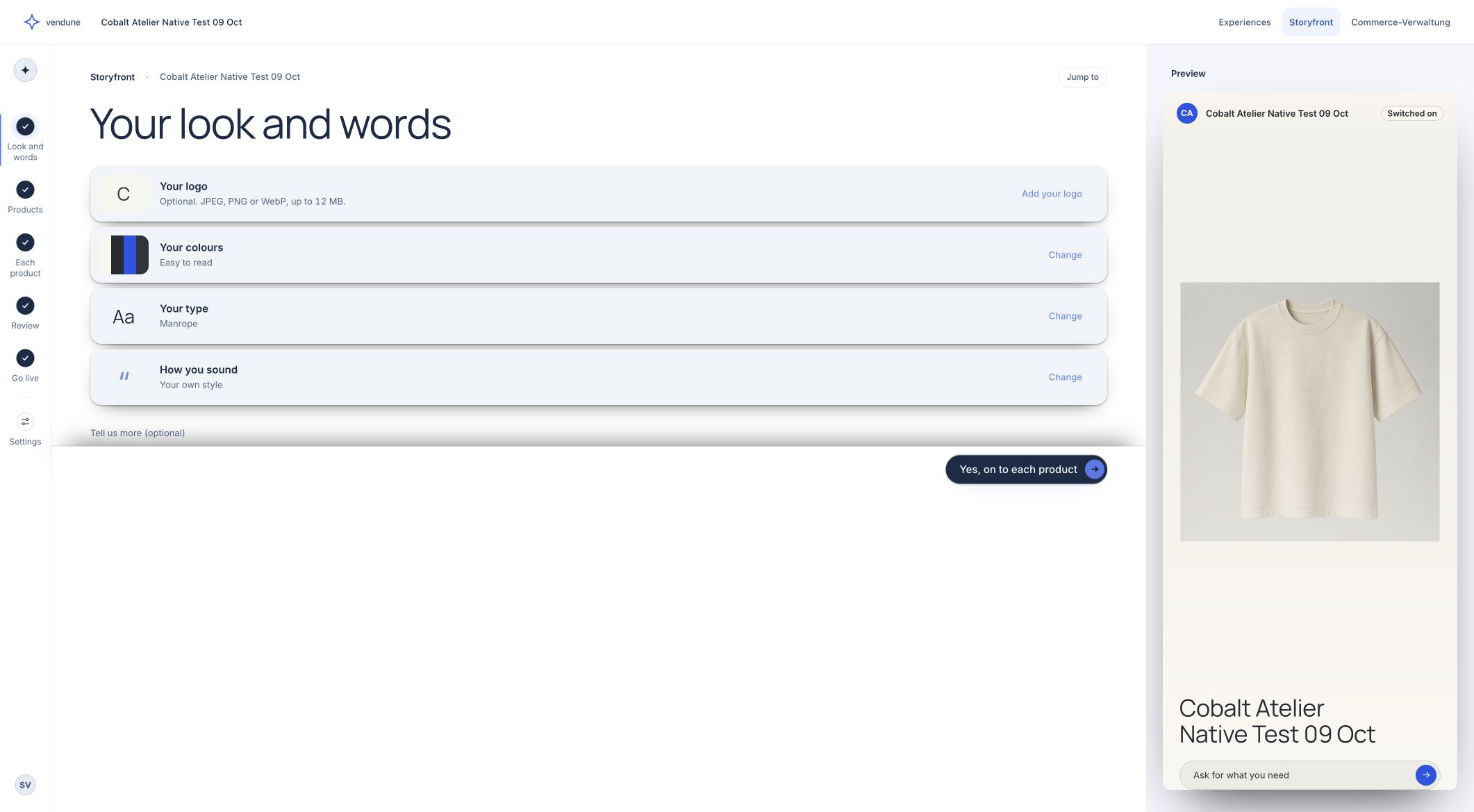
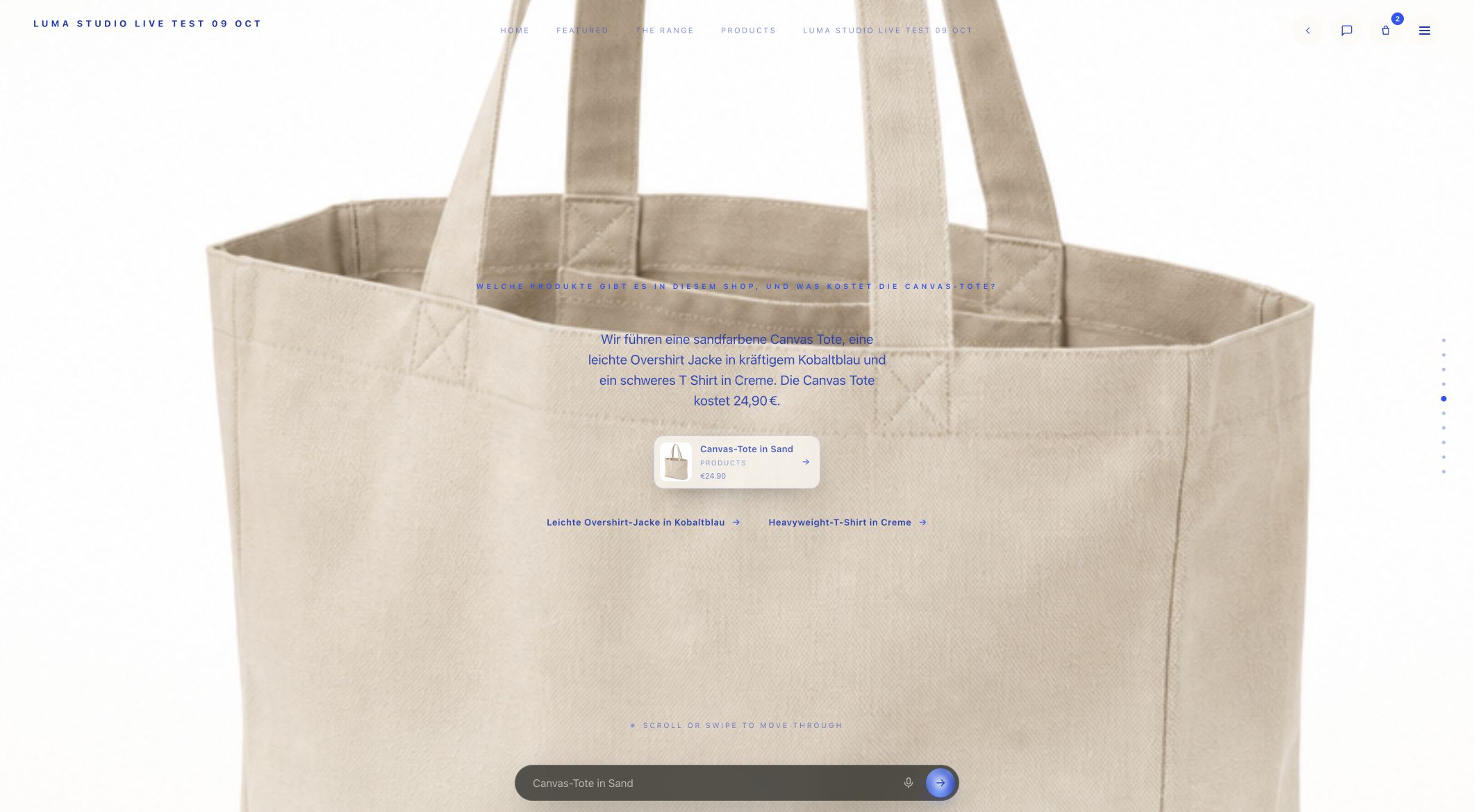
A freshly verified Cobalt onboarding accepted three actual model-proposed demo products, generated three product images, stored four catalog languages and opened the original Studio. Original review, worker Build and Go live completed for Cobalt and the existing Luma catalog. An original writing-style edit survived reopening and service replacement. A real German question in Luma produced a new original multi-chapter scene naming its three products and correct 24.90 EUR Tote price. The native Bag opens with item counts, removal and total; a 390px check measured 390px document width.
PR #79 fixes hosted original public
API routing with current tenant/channel/preview admission. Private PR #42 removes
intermittent module activation failure by sharing only still-running admission
checks, immediately forgetting completed checks. No stale authorization cache or
quota bypass is introduced. PR #80
keeps the native checkout transfer on the shared /checkout route. Its merged
Core b995b5a is deployed as dependent-floor-9352; the new pod passed its health
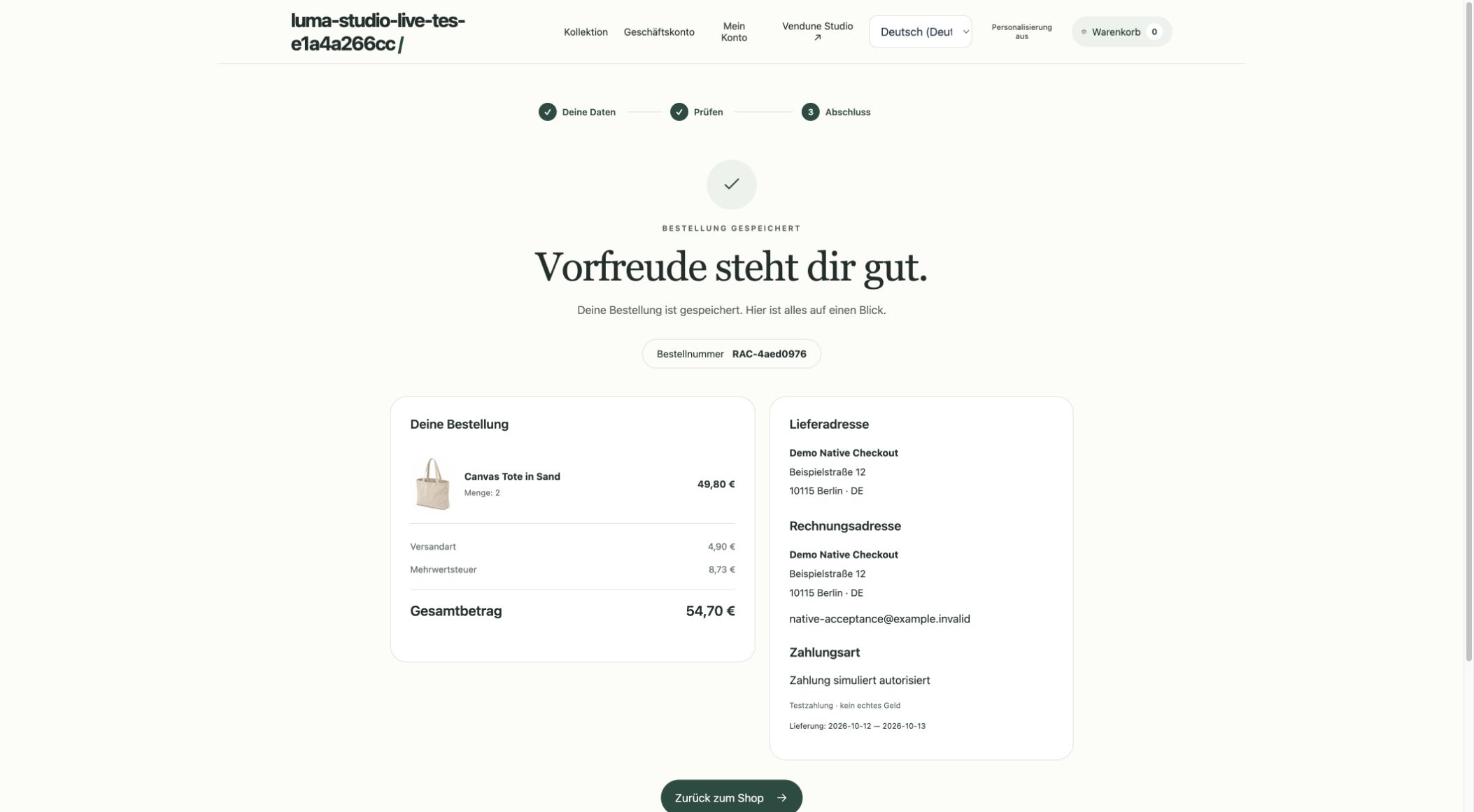
check. The actual original Bag transferred two canonical Canvas Totes into the
shared checkout. Fictional address entry, standard delivery and simulated payment
saved RAC-4aed0976, 54.70 EUR total, 4.90 EUR shipping and 8.73 EUR VAT.
The receipt confirms simulated authorization; no money was charged. The return
button exposed a separate SPA-navigation defect, repaired with canonical hosted
navigation while preserving local SPA behavior and channel/language scope.
Original intro/controls still include English copy. Universal native worker provider inheritance, complete advanced-media import, externally settled payments and production capacity are not established by these tests. Existing retained renderer shops only switch after completing original Go live.