 Vendune
Vendune
Your storefront. Your apps. Your AI. One commerce core.




Start locally · See it in action · Interactive demos · Full feature tour · Latest release · Build an app · How it works · Documentation
Vendune is a self-hosted Rust commerce system for B2C and B2B shops. Run a storefront, manage it in Vendune Studio, build custom experiences and give agents access to the same catalog, prices, inventory and checkout. AI retrieves shop knowledge and proposes changes; you review the exact changes before they go live.
| Run your shop | Build your experience | Keep control |
|---|---|---|
| Products, variants, customer accounts, orders, taxes, shipping and documents | Visual App Studio, typed data, custom storefronts, HTTP/MCP actions and app services | Private sandboxes, selected releases, scoped team access, version history and central AI settings |
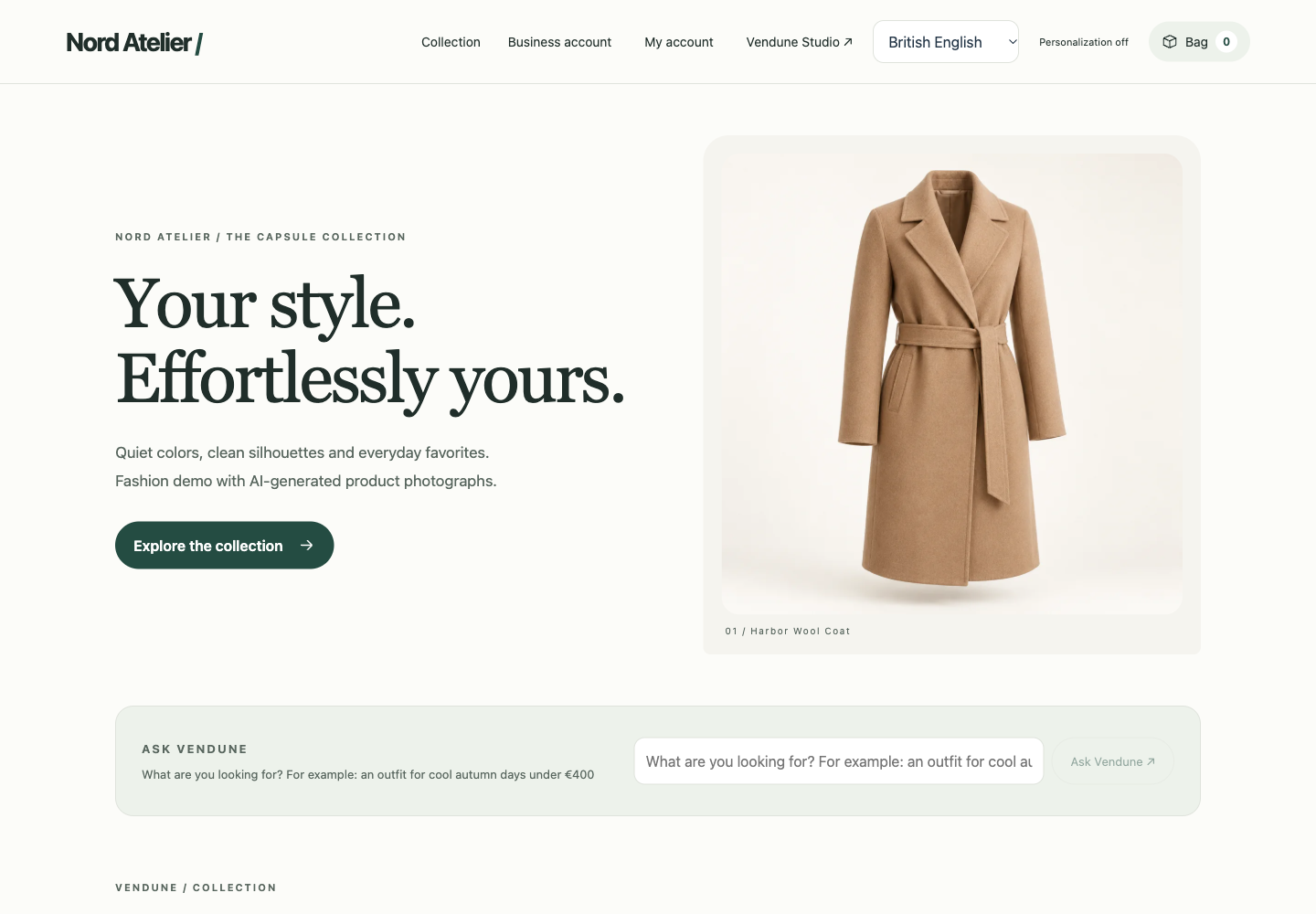
Meet Nord Atelier. The default demo has 12 fashion products, 34 purchasable SKUs, seven categories and four content languages, with individually generated product photographs included. Choose a size, add it to your bag and follow the real checkout. Explore the collection.
The responsive checkout includes touch-sized controls, a fixed order action, address validation and optional opt-in Google Places completion. Accepted orders open a durable confirmation page with a finite, reduced-motion-aware confetti animation. Checkout setup and limits.
Working prototype. The captures use isolated synthetic shops and simulated payments. Current capabilities and remaining production work are described below and in the complete feature guide.
Core hardening: explicit route permissions, trusted request identity, non-owner RLS deployment, shared tenant/connection budgets, persistent login throttles, transaction-mode PgBouncer and recoverable poison-event handling now use the existing commerce owners. All eighteen fixes, architecture and verification boundaries.
Connected intelligence foundation: automatic batched embedding intake and model rebuilds, hybrid text retrieval with optional reranking, authorized agent read rounds, native chat progress, source-bound merchant-reviewed claims, signed facts, price guardrails/daily autonomy budgets, controlled layout experiments and private consent-bound cart preferences. Categories can select products through saved, localized queries of current confirmed public facts; source withdrawal removes the corresponding fact membership. Document events can invoke opt-in extraction flows through the same rights, review and daily AI quota as HTTP/MCP. Public product answers recheck every supplied source and the native product after inference; concurrent withdrawal or changes return localized retry guidance. How they connect, setup, evidence and remaining audit work.
Graph-native apps: map app-owned nodes, relationships and selected native fields in App Studio or the same coding-agent manifest. Current tenant rights and record revisions remain authoritative across API, MCP and planner context. Example and contract.
Merged release and acceptance: complete change summary, integration paths and measured test gaps. Current checkout-release CI covers 187 Rust units, 393 frontend tests and the registered integration suites; hosted rollout and real providers have separate acceptance gates.
9 October public update: the private Experience service now runs original Storyfront Studio and Cinematic presentation. Fresh AI catalog/image creation, original review/build/publication and a live German product-answer scene were checked. Core still owns prices, stock and orders. Live acceptance and remaining boundaries.
One experience through checkout: the original Storyfront now embeds the same Vendune checkout, keeping the shop URL. A public mobile demo purchase saved the German product name and cleared the original Bag after server confirmation, including after reload. Canceling keeps the Bag. The original Studio overview uses the actual connected catalogue and live address. Screenshots and exact acceptance.
Get started
Rust stable 1.96+ · Node.js 22+ · Docker Compose · Python 3
git clone https://github.com/sthamann/vendune.git
cd vendune
./scripts/dev.sh
Open the storefront or Vendune Studio. Choose Create shop on the Studio login page to create your personal owner account and a separate shop. The fashion demo, variants, cart and simulated checkout work without a model download or provider API key.
Your first round: choose a coat size → place a simulated order → inspect it in Studio → create a sandbox → try a product change → review its release. Follow the illustrated tour.
The first start builds the frontend/Core and starts PostgreSQL/Qdrant; allow a
few minutes. Private credentials are generated in ignored .env. Keep the
terminal open; Ctrl+C stops the app and retains the database.
Full setup and troubleshooting.
Add a model, connect an agent or run the legacy playground
- AI: use centrally configured Ollama, OpenAI Responses or Anthropic Messages. Provider setup · Optional local Ollama. The documented local model download is about 24 GB; runtime needs additional memory. Cloud API credentials and charges are separate from consumer chat subscriptions.
- Agents: connect a local MCP client. Hosted clients need a reachable HTTPS endpoint and account-side registration; OAuth-based clients additionally need an appropriate gateway.
- Another instance: use separate ports, credentials and volumes.
- Legacy furniture walkthrough: the playground CLI
exercises mug/lamp fixtures, TRY10, personalization and an invoice flow.
Select
DEMO_CATALOG=legacy-furnitureand restart before creating that shop. Keep the normal fashion default for Nord Atelier; existing shops retain their data.
See Vendune in action
Shop, review, place the order
One checkout combines contact, billing/delivery addresses, shipping, payment, coupons and the authoritative total. Review order and Place order are separate steps. A changed quote needs a new review; repeated requests return the same saved order. Inventory and immutable order snapshots commit together.
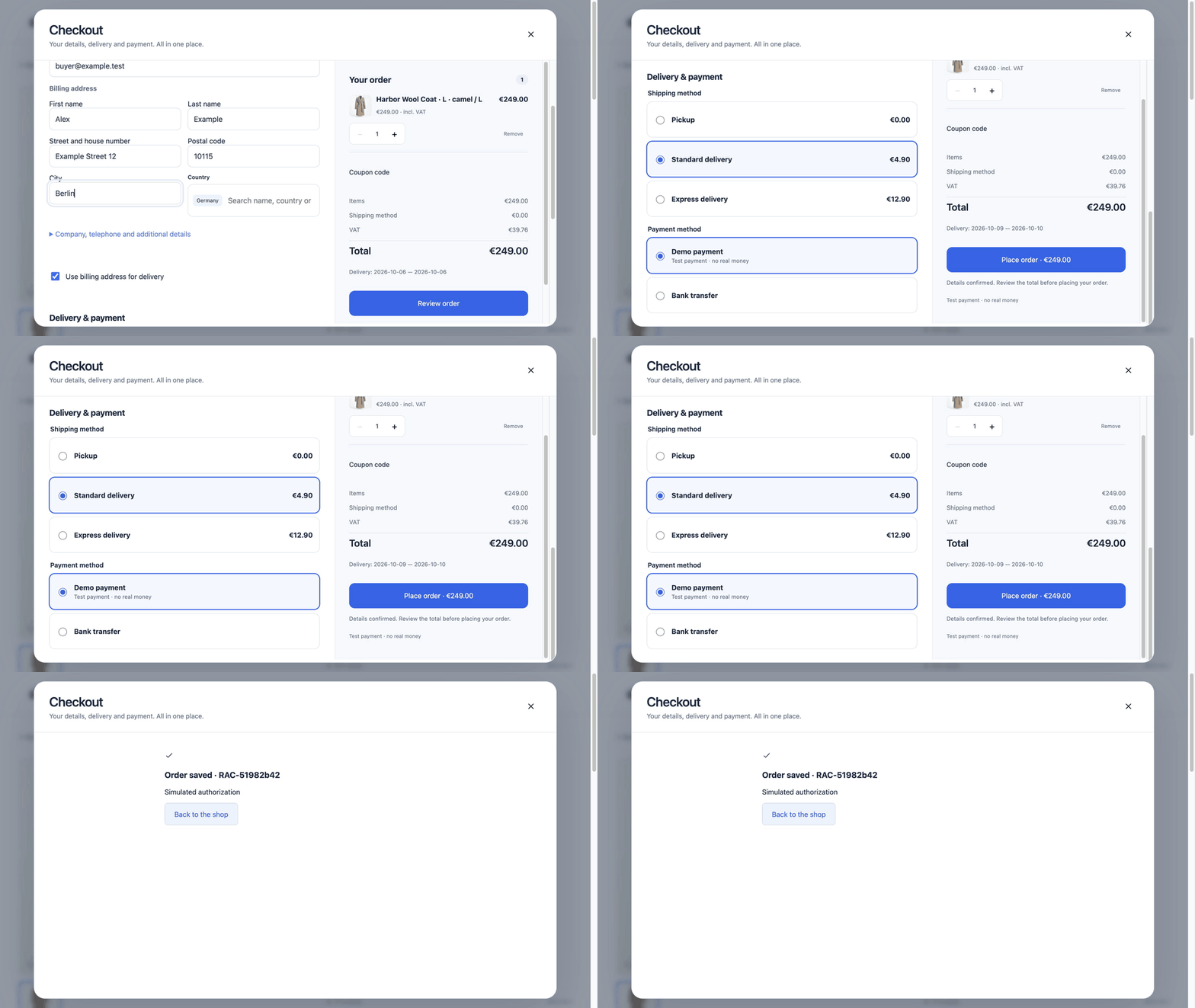
Real checkout interaction in the Nord Atelier test shop. The payment is simulated.
The product editor brings visual/Markdown descriptions, translated content, prices/stock, reviewed variant combinations, galleries, category/channel visibility, specifications, SEO, cross-selling, downloads and reviews together. Public shops use their own subdomain; product links use stable SKU addresses with inherited localized SEO slugs and support direct reloads. Explore commerce.
Intelligence beside the work
Ask Vendune opens beside products, orders, customers, settings and app workspaces. It prepares an editable question with the current workspace, staging environment and linked entity reference. The existing conversation, evidence and permission-checked proposals stay connected; opening help preserves the product editor.
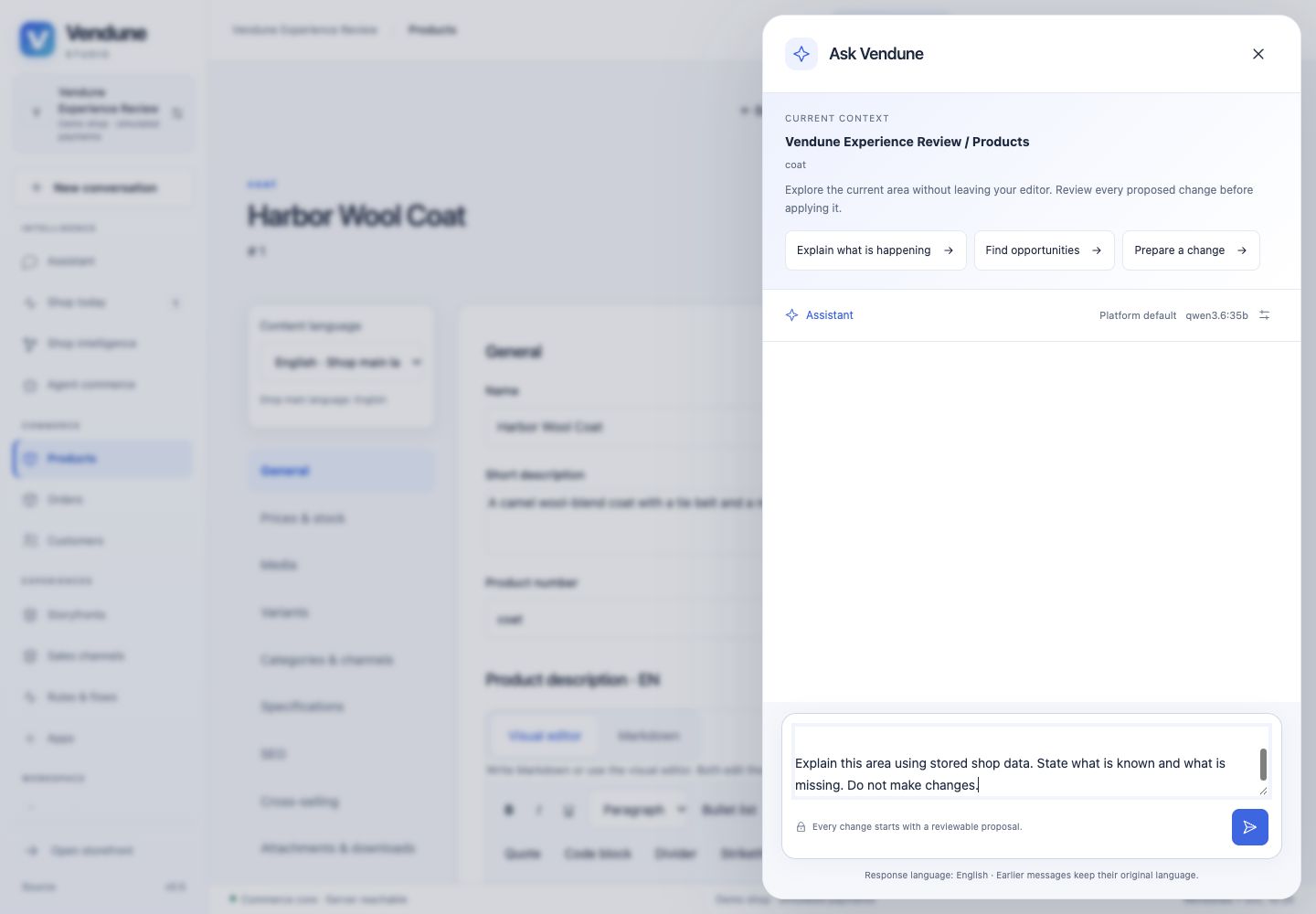
Actual local Studio screen; the question is prepared, with no model call or automatic change.
Stay connected after checkout
A separate sign-in and registration leads to a responsive customer account: independent default billing/shipping addresses, cursor-paginated purchase history, immutable order details, current delivery and payment state, HTTPS tracking links, issued PDF documents and entitled digital downloads. The storefront uses customer sessions and ownership checks, never merchant credentials.
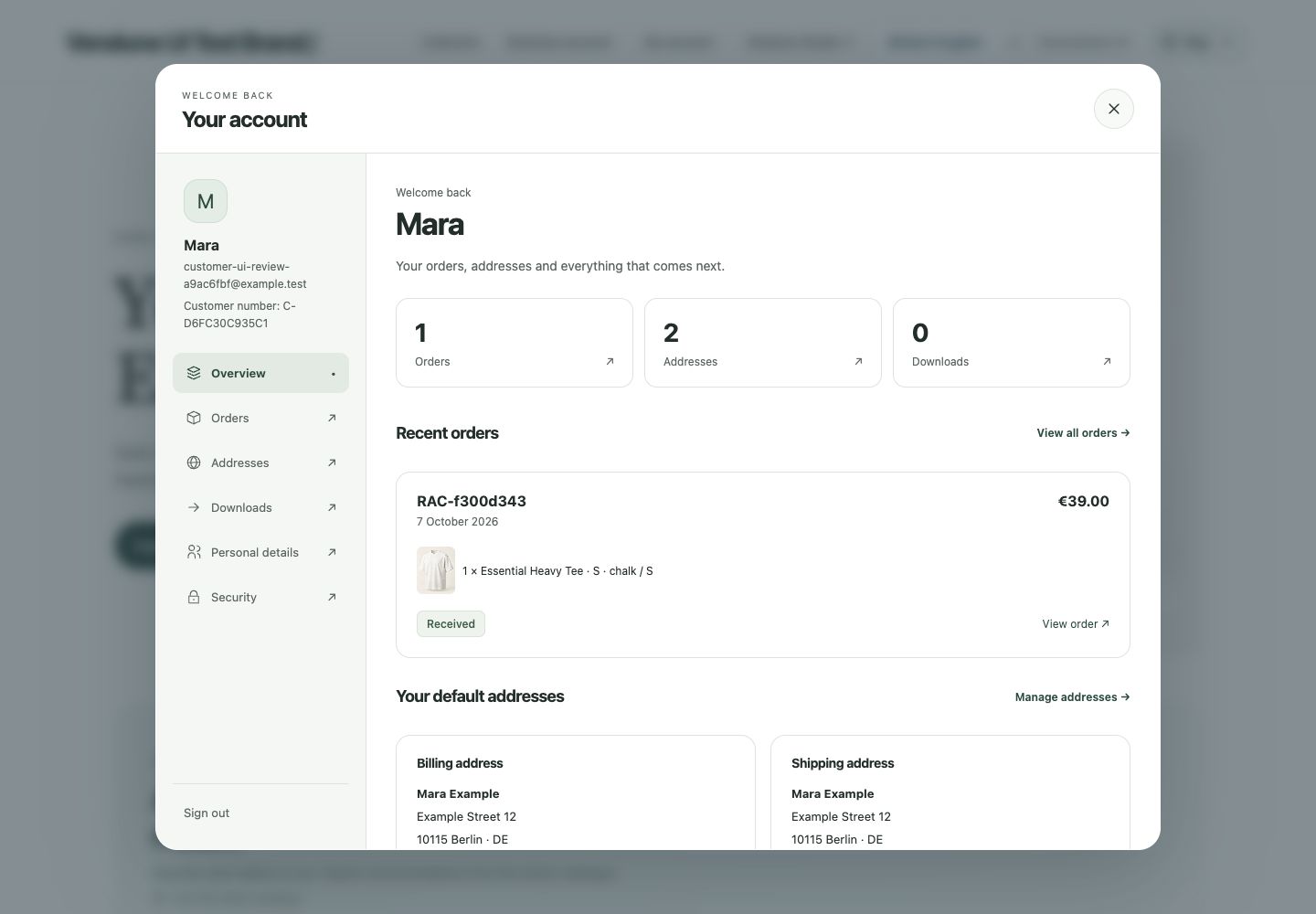
Actual account interaction in an isolated Nord Atelier test shop; all purchases are simulated.
Operate in Europe with connected privacy and legal controls
Settings → Legal & privacy brings a source-linked sector checklist, inherited channel documents, provider disclosures and a private consumer-request workspace together. The storefront starts optional tracking denied, supports equal privacy choices and revocation, gates analytics/media/maps/personalization, and exposes an online withdrawal function. Strict server checkout binds current legal documents and separate digital-delivery approval to immutable orders. Email and Flow Builder use the same durable events. Configuration, architecture and exact legal/technical boundaries. Reviewed legal texts and sector-specific obligations remain the operator's responsibility; strict checkout defaults off in demos.
Give AI evidence. Review its changes.
Products, uploaded text/PDF sources, curated relationships, observed purchases and configured app evidence meet in Shop intelligence. Test retrieval, inspect passages and source identity, and explicitly publish eligible knowledge for shoppers. Merchant-private evidence stays within authorized merchant use.
The assistant keeps conversations and inspectable proposals. Approved changes use the same permission/revision checks as manual edits. Translation and image jobs produce private drafts. Choose Ollama, OpenAI or Anthropic; ordinary commerce runs independently of inference.
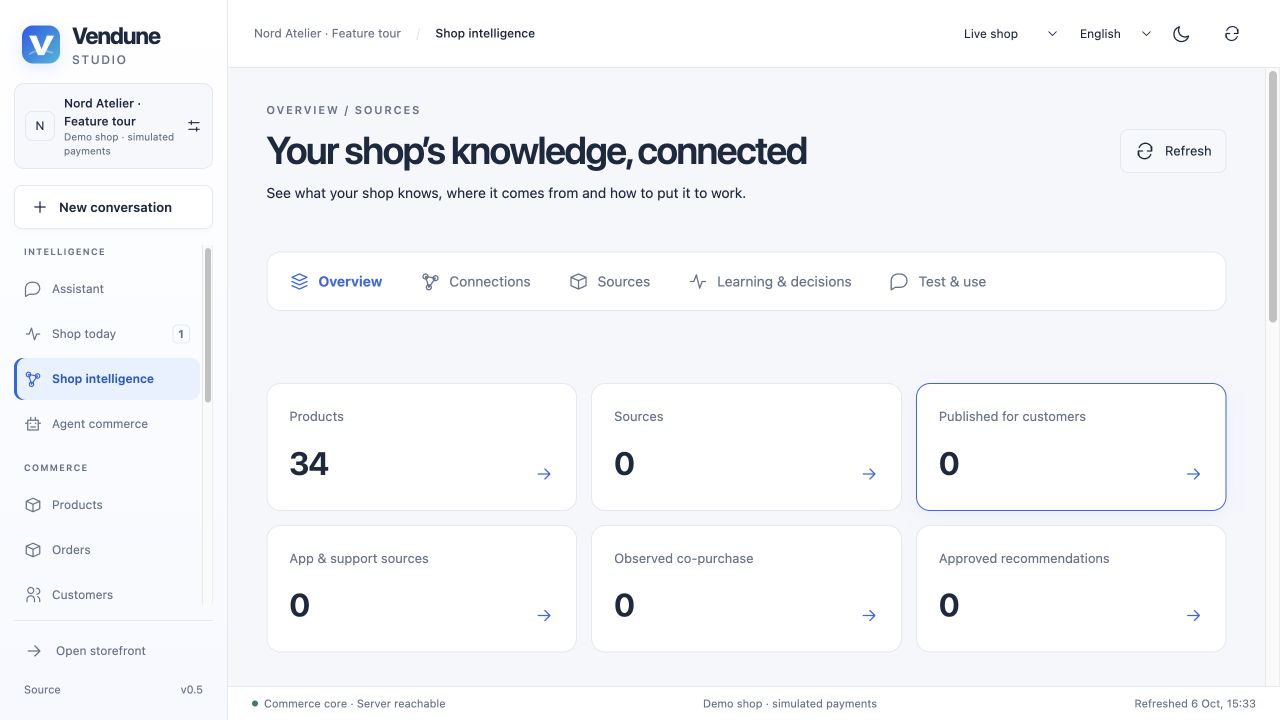
Stored knowledge and observations are distinct from model-weight training; observed associations do not establish sales uplift. Knowledge and AI tour.
Build an app that belongs in your shop
Visual App Studio and coding agents share one executable manifest. Compose a snapping form raster with controls, data grids and code-behind; define typed models; add product, customer or order fields; choose public reads, HTTP/MCP tools, AI access and Flow actions deliberately. F5 runs actual records in an actor-private sandbox with hot reload. Autosave drafts, inspect calls and breakpoint traces, save an immutable version and publish selected changes.
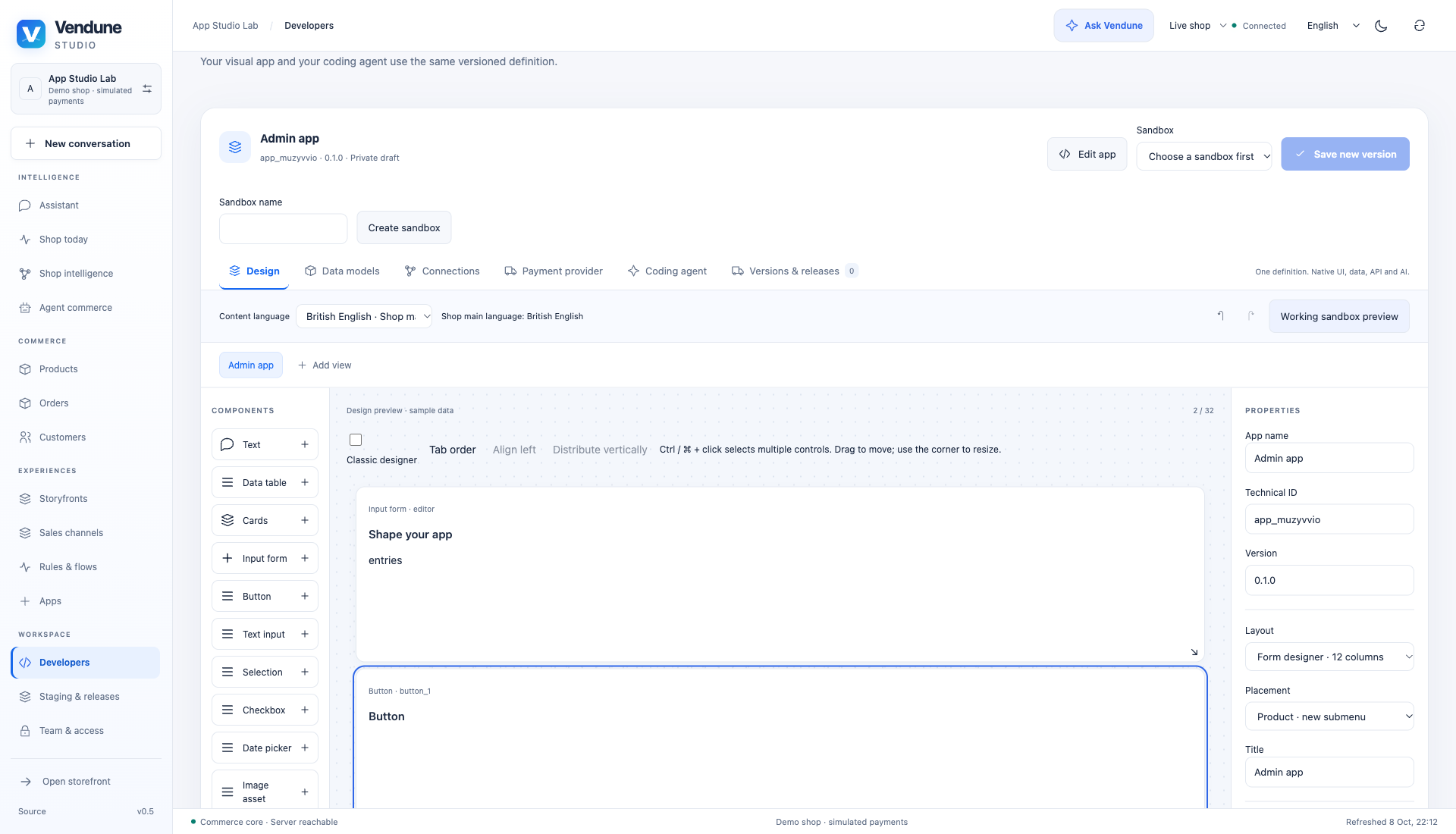
Actual browser capture, 8 October. The design canvas labels sample data; the working private preview shows a product-bound record saved and reloaded through PostgreSQL.
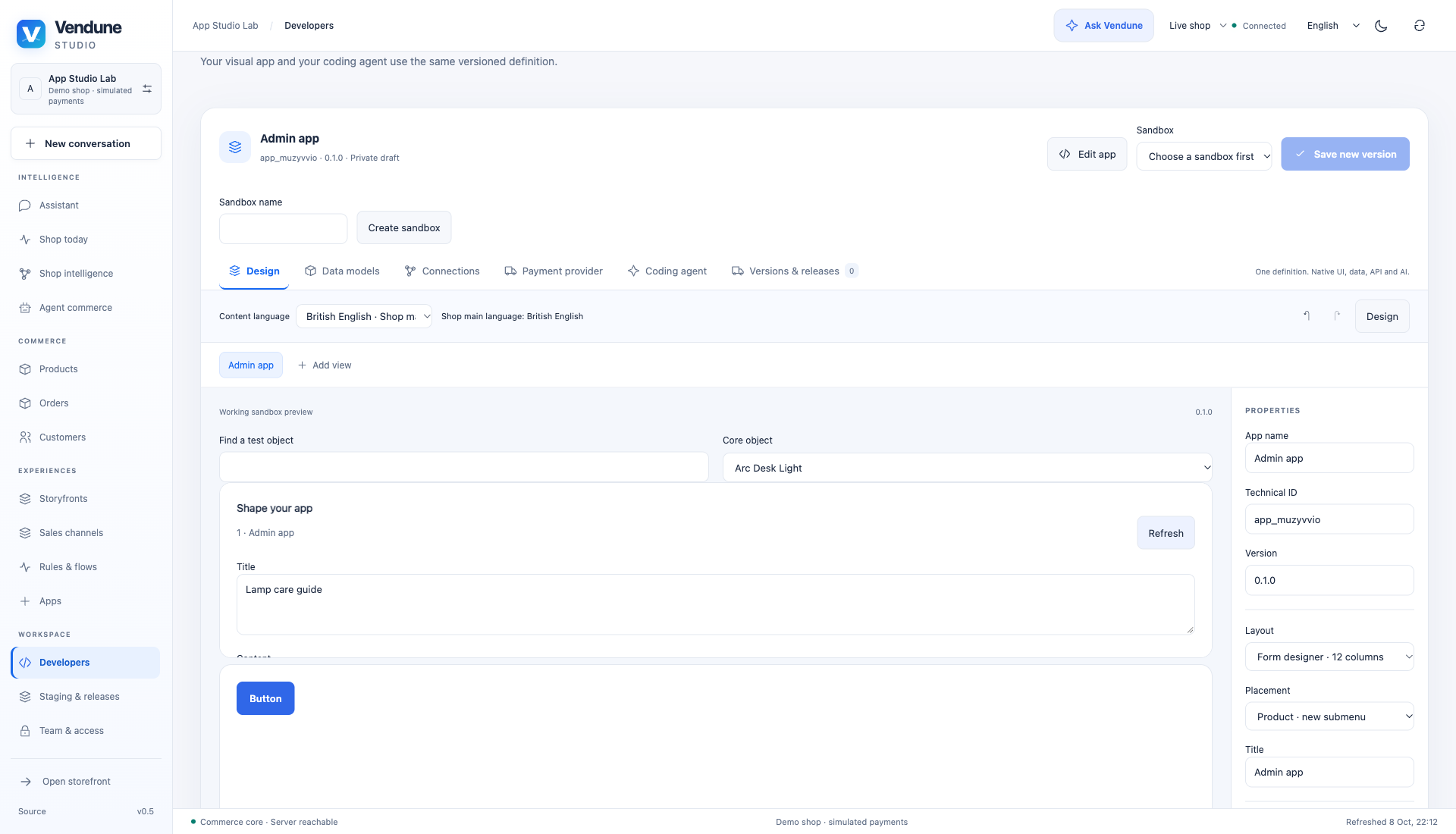
Nine assistants cover storefront/admin apps, connected experiences, connectors, events, webhooks and schedules. Separately deployed services can bring their own frontend, database and capabilities through the scoped SDK. App Studio · Guided contracts · Full app SDK · App security · Runnable Product Lab.
Make the process visible. Publish what you choose.
Rules and campaigns feed a graphical Flow Builder with Yes/No branches, consecutive actions, durable delays, documents and configured app actions. Execution traces show actual results and errors. Signed app webhooks and UTC schedules connect external events to the same durable path.
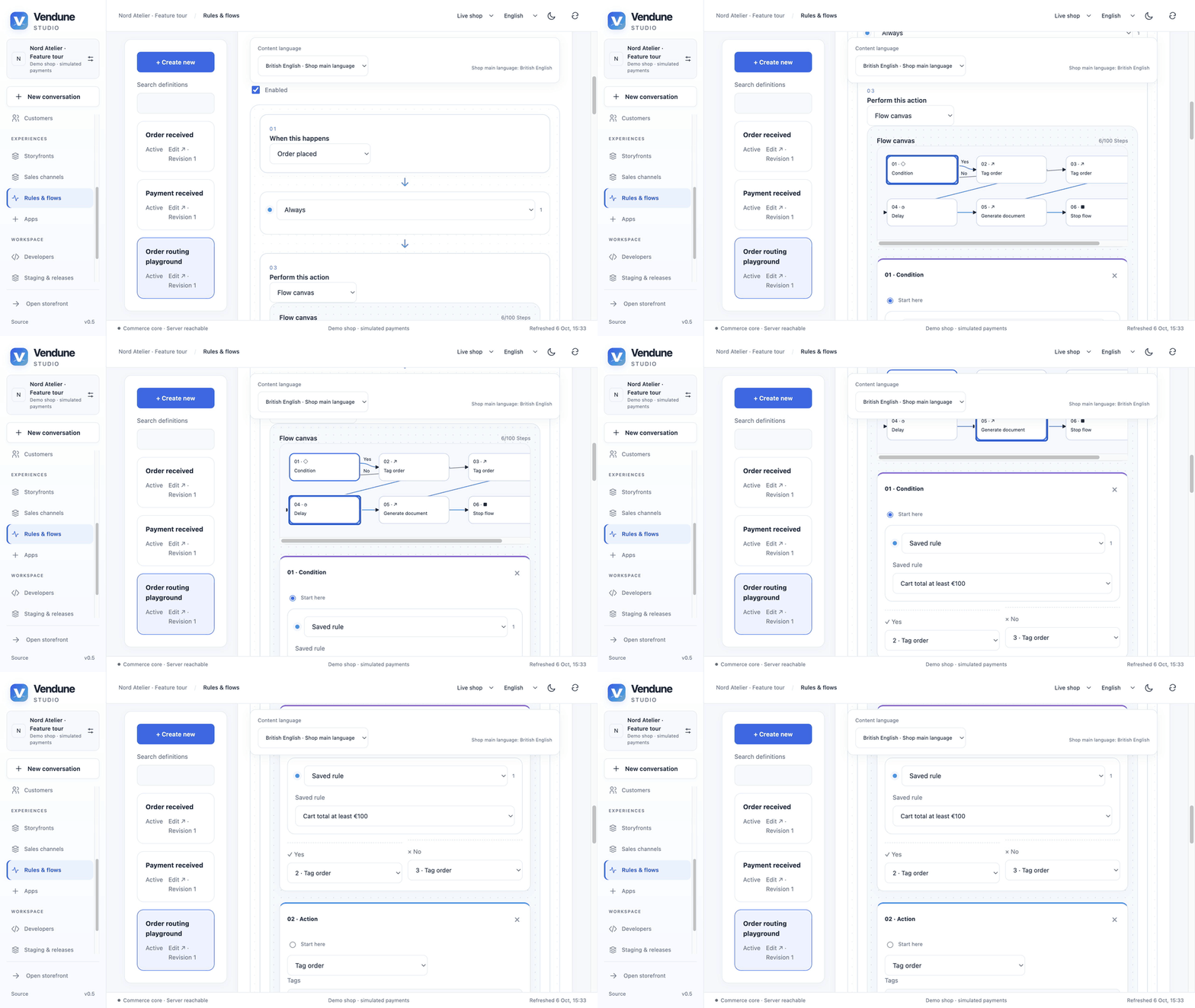
Inspect the saved six-step flow. This editor recording does not assert an external delivery.
Compare a private stage with its live baseline, select changes and publish them atomically. Product content releases preserve live inventory. Version history supports validated content restoration, without replaying financial operations.
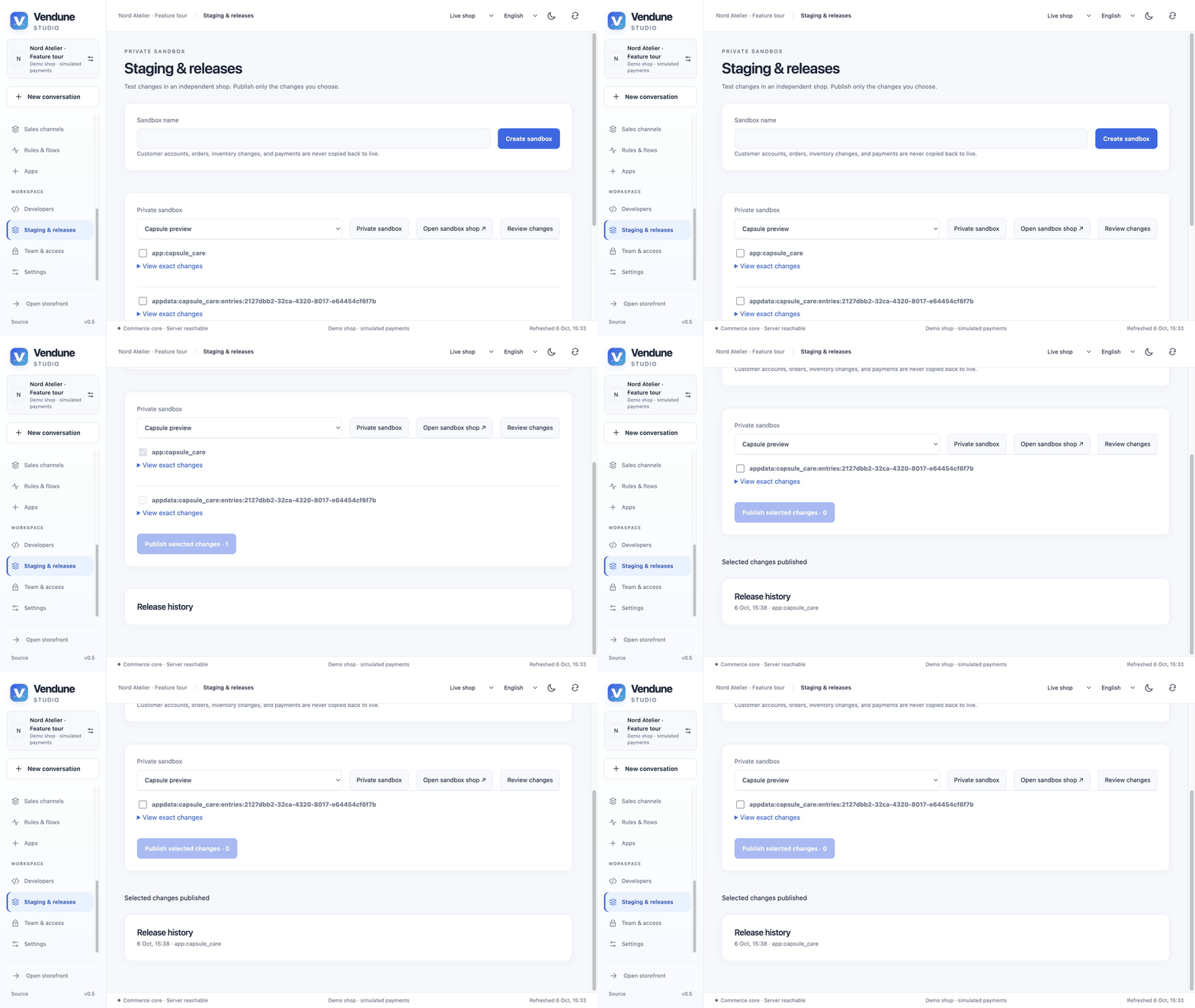
Package and app-data publication are independent. The unselected data stays in the sandbox.
These are real browser captures; waits are shortened for readability. The complete tour retains 40 screenshots and 12 interaction GIFs from 6 October, alongside three new public integration captures from 8 October and two current App Studio captures. Capture versions, recording edits and live-provider limits remain explicit.
Operate the whole platform
admin.vendune.ai is the entry to merchant and platform sign-in. The separate operator console creates shops, inspects their dossiers, and supports pause, recoverable trash and restore. Configured wildcard routing gives shops subdomains; diagnostics probe the actual database, index, pools and queues. HTTP diagnostics distinguish access refusals, other client responses and server failures, with exact response codes. Older totals remain visibly unclassified; read the measurement boundaries.
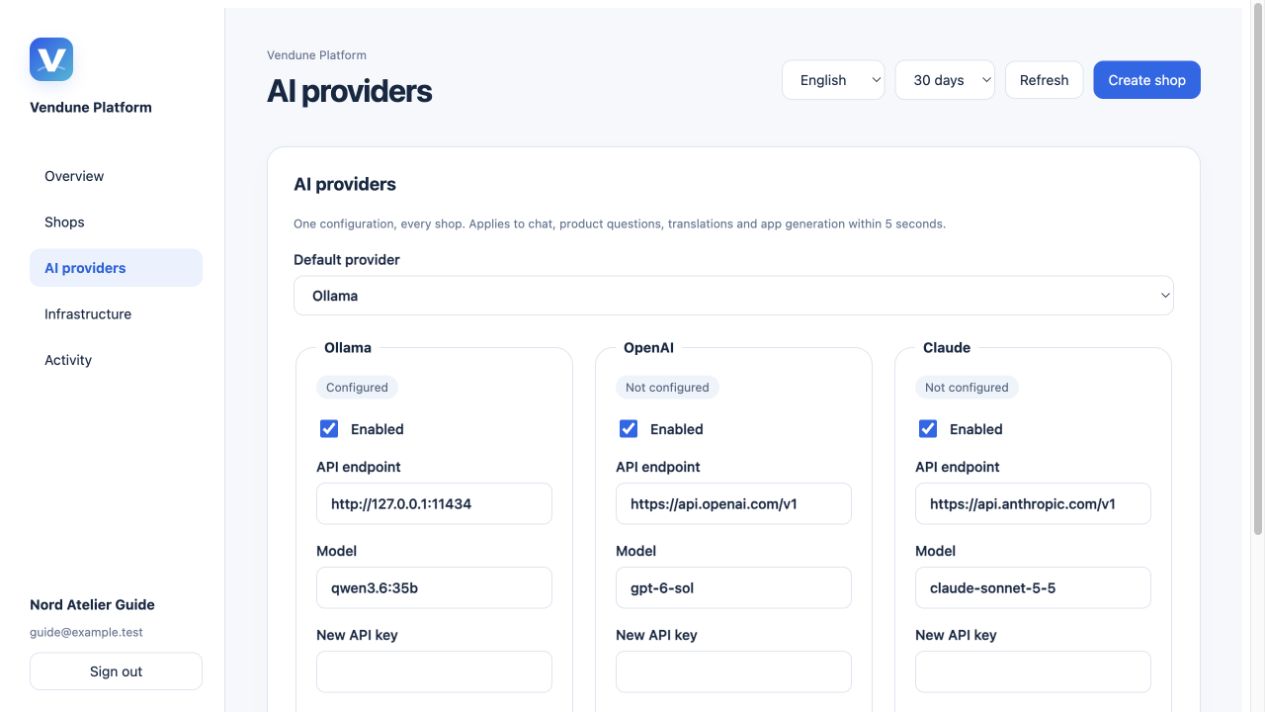
Central encrypted Ollama/OpenAI/Anthropic settings are inherited or overridden per shop. Chat, app generation, translations and AI proposals share that selection. Keys stay server-side; “Configured” reports settings, not provider health.
Connect your own experience. The latest opt-in integration adds trusted server-side merchant identity, owned shop provisioning, structured inference, one-use Studio handoff and channel-bound hosted frontends. Public frontend traffic uses a restricted proxy. The trusted identity service and its credentials remain operator-managed; this is not a deployed Google/Apple OAuth service. Experience integration · Platform guide.
Explore the connected system
| Area | What is connected | Guide |
|---|---|---|
| Catalog & channels | Search, eleven editor tabs, translated category trees, variants, guided storefront/headless channels, domains, pause/resume and personal previews | Products · Channels |
| Customers & orders | Responsive customer workspace, separate sign-in/registration, default billing/delivery addresses, purchase details, HTTPS tracking, owned invoice PDFs and paid downloads; Studio fulfillment, guest buyer contacts with linked purchase addresses/orders, and customer groups | Operations · History |
| International settings | Company/channel inheritance, enabled content locales, countries, destination taxes and eligible shipping/payment methods | International commerce · Settings |
| Knowledge & automation | Published/private sources, reviewed recommendations/proposals, coupons, rules, event graphs and durable workers | Knowledge · Automation |
| Apps & developers | Eight bundled apps, nine builder assistants, typed storage, SDK surfaces, scoped API keys, HTTP/MCP tools, schedules and webhooks | App library · App contracts |
| Platform & experiences | Shop domains, inherited AI, lifecycle, diagnostics, trusted identity, private stages and selective releases | Platform · Experiences |
Connected experiences, managed in one place
Experience onboarding installs the Storyfront integration in the same transaction that connects its frontend. Apps, Storyfronts and Sales channels → Domains & experiences show the same owned connection and open the deployment’s existing editor. Pause a channel or make it private without deleting its orders. Storyfront implementation stays private; installation does not publish a draft or activate the original native renderer. Current release and deployment boundaries · Connections and dependency checks.
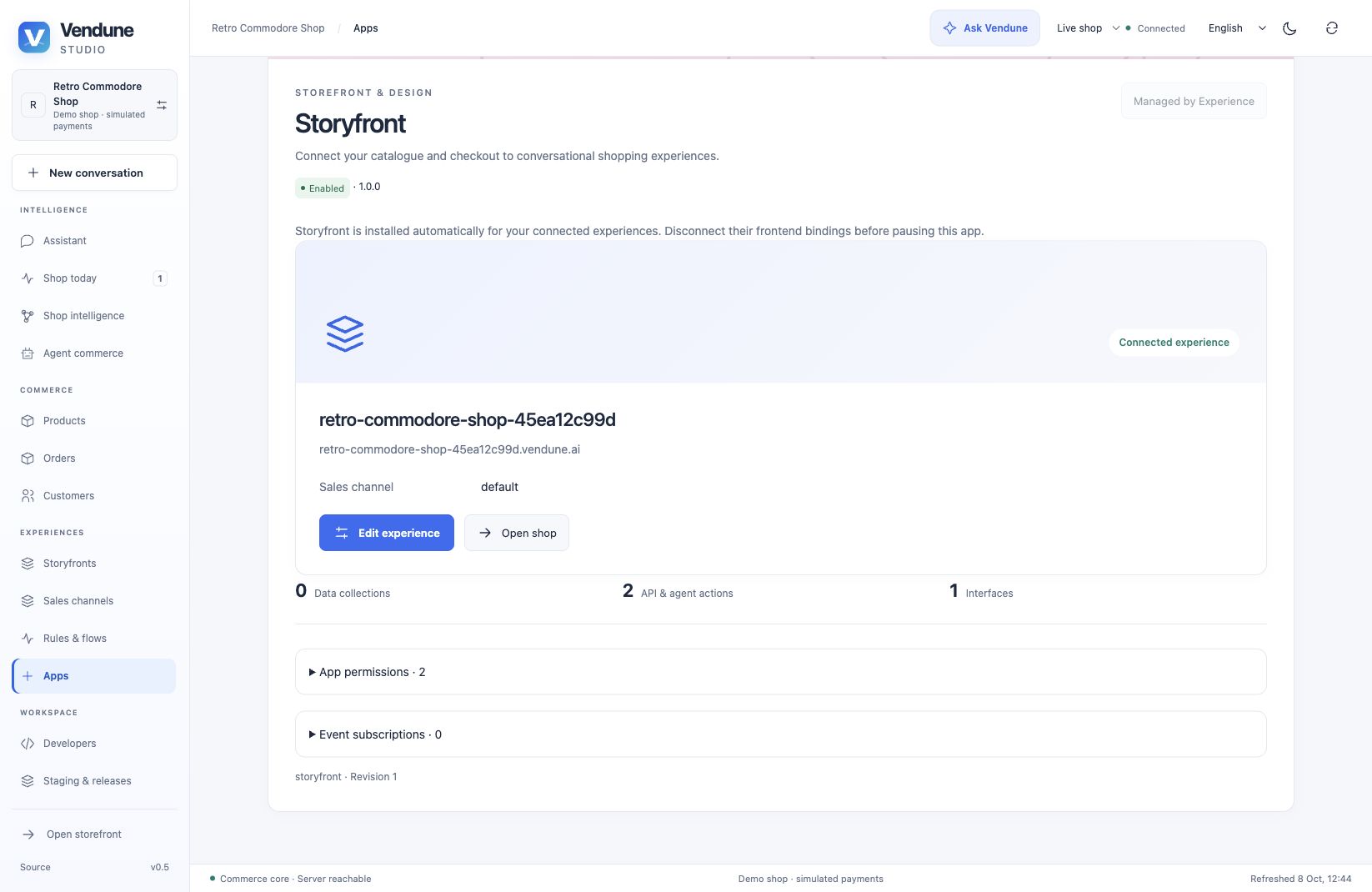
The eight bundled apps are Personalize this product, PayPal, Shopware Payments, Storyfront, Google Analytics, Gmail, Slack and Email delivery (SMTP/Resend/SendGrid). Each has explicit setup and permission boundaries; installation does not silently connect a provider. App capabilities.
Studio has 15 workspaces in English, German, Spanish and French, plus dynamic content locales with main-language inheritance. Developers get scoped keys and an explorer generated from the current Rust routes (279 static HTTP method/path pairs in this implementation, reviewed 9 October 2026); installed app routes are discovered per shop. CI rejects catalogue drift. Studio/API tour.
Multiple currencies, one checkout
Choose shop and sales-channel currencies, expose a storefront selector and use fixed localized prices or the latest stored exchange rates. Generate product and variant prices in durable batches. API, MCP and UCP checkout share the same currency context; payments, refunds and invoices retain their original precision. Configure currencies and pricing.
Inside the core
Rust + PostgreSQL + private Qdrant + bounded Wasm extensions. Browser, HTTP, MCP and UCP clients reach shared commerce operations with authenticated scope and revision checks. PostgreSQL owns orders, stock, users, app records, knowledge and queues. Qdrant is a rebuildable retrieval index whose candidates are checked against current records and publication state.
Independent workers process events, payments, knowledge, translation and media. External calls stay outside database transactions; approved Wasm policies have bounded fuel/memory and no network/filesystem access. Architecture · Source map · Worker roles · Wasm examples.
Evidence you can inspect
| Evidence | What it establishes |
|---|---|
| 7,000 original-PHP comparisons | Bounded pricing, context, shipping-tax, rule and comparison behavior against reviewed Shopware sources. Parity matrix. |
| 45 extracted production policies · 97 Lean properties | Exact named pure decisions, Rust/Lean conformance and rejected negative mutations. Surrounding SQL/providers/browser behavior remains outside those proofs. Formal boundary. |
| 1,000,000 products + 1,000,000 translations | Dated local commerce workloads with retained raw measurements and failures; not production capacity or a Shopware speed ratio. Benchmarks. |
| Translation workflow | Four-language Studio, platform, checkout and bundled app controls; shared content inheritance, additional shop content languages and translator-friendly catalogue export/import. How translations work. |
| Continuous verification | Source ownership, localization, Rust/frontend checks, real PostgreSQL integration, original PHP comparisons and Lean/mutation gates. CI · Testing. |
Production architecture
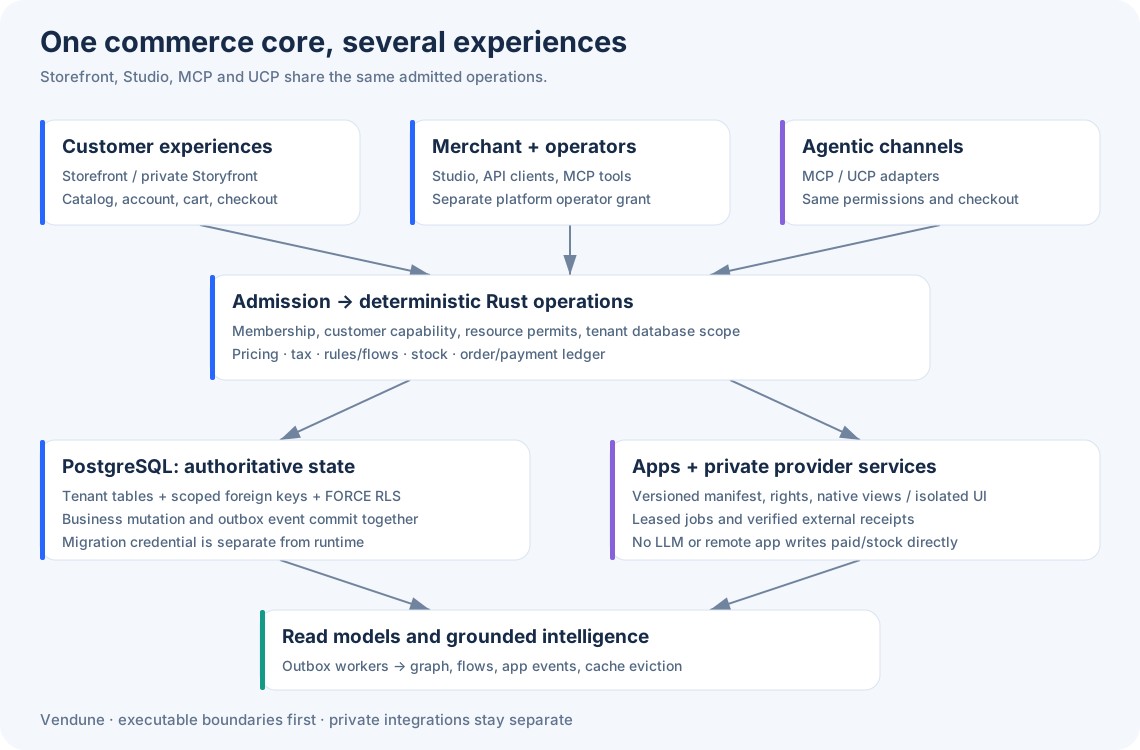
The core now includes an exact money boundary with explicit currency scale, strict
RLS deployment checks, allocations for all payment methods, a central payment state
machine, commit-driven cache eviction, resource admission, shared daily interactive
AI quotas and operator latency histograms. Native public assets skip database authentication;
shop admission shares one fresh SQL snapshot, dashboard reads are consolidated,
settings use immutable Arc handles, and storefront/build assets support gzip/Brotli.
A matched local 9,000-request comparison retains raw samples, payload sizes and
unchanged-response checks: read-path measurements and limits.
Follow the complete request, checkout,
security and intelligence paths, including rendered
diagrams, source locations, configuration, tests and the remaining production gaps.
The ported pricing slice deliberately retains Shopware float behavior; a complete
integer/decimal pricing migration must continue to pass its original-source gates.
Rust standard services
Email Delivery, Google Analytics, Gmail and Slack now run in a separate Rust service. Their configuration, source exports and notification queue use encrypted, tenant-scoped PostgreSQL records. Multiple workers share fenced leases and per-shop limits; uncertain external results are never blindly retried. API, MCP and Flow Builder contracts remain unchanged. External apps still choose their own language.
Architecture and SQLite migration · Email setup · Connected apps
Current boundaries
| Area | Current scope |
|---|---|
| Production readiness | Working prototype. Recovery/MFA, complete token/spend quotas, automatic relocation/failover, legal compliance and full-system coverage remain additional work. |
| Payments & connected services | Simulated/manual payments, native PayPal Orders v2 and a versioned provider API for isolated payment apps: onboarding, redirect/embedded checkout, capture/authorize/void/refund, signed callbacks and Flow/MCP actions. App Studio edits the same contract. Local fixtures are tested; real PSP outcomes and the private Shopware Payments service require approved provider configuration. |
| Tenant isolation | Scoped API/MCP operations, tenant-aware foreign keys, core FORCE RLS policies and connection-scoped runtime enforcement. Strict deployments require a separate non-owner runtime login; policies alone do not protect a superuser. Exact isolation boundary. |
| Shopware & protocols | Selected native behavior ports and HTTP/MCP/UCP capabilities; complete DAL/CMS/plugin compatibility and full protocol conformance are outside this slice. |
| Custom apps & hosting | Declarative packages plus separately deployed services. Canonical Ed25519 package signatures, dependency checks and hash-pinned UI bundles are implemented. Arbitrary source builds and hostile-code microVM containment remain external deployment responsibilities. Deployment/health availability does not certify production checkout. |
Security · Managed hosting · Complete feature scope.
Adding another settlement rail requires invoice-bound server verification and ledger integration. Payment provider requirements and current limits.
License and contributions
Source available under the Vendune Sustainable Use License 1.0. Run and customize your company's own stores, brands and apps. Selling a competing shop system, white-labeling or providing managed commerce/SaaS for independent merchants requires a separate written commercial license.
This is not an OSI-approved open-source license. Earlier MIT-distributed versions retain their original rights; third-party terms remain intact. Usage examples and commercial inquiries · Third-party notices.
Bring a reproducible commerce bug, a useful extension, a locale correction or a bounded Shopware port with original-source comparisons. Contribute · Open an issue · Changelog.
Channel management and private previews
Existing sales channels now support revisioned editing, pause/resume and public/private visibility, including the main channel. Each channel displays its connected domains and canonical Experience editing links. Additional addresses and disconnect operations reuse the tenant-owned frontend registry and dependency checks. Personal 15-minute previews are session-bound and cannot purchase. See workflow, APIs, security and native Storyfront limits.
Checkout inside connected experiences
Connected original Storyfront experiences can open Vendune’s existing checkout in a native overlay, keeping the shopper on the experience domain. Completion is verified with Core before the original bag is updated. Checkout order labels use the cart language and remain immutable. The original Studio overview recognizes the connected catalogue and published address; its overview and shell vocabulary have English, German, French and Spanish translations. This is scoped translation coverage, not a claim that every original upstream editor is translated.
See the checkout continuity contract for ownership, security boundaries, tests and payment-provider limits.